There's a crab the size of your fingernail, white and blind, living in a lake inside a cave in the north of Lanzarote. And it doesn't exist anywhere else on the planet. Not on another island, not in another cave: just there, in that pool of water.
That pool sits inside Jameos del Agua, the first work César Manrique built on his island and the one that started it all. And the Jameos are one of the CACT, Lanzarote's seven tourist gems.
Here we'll tell you exactly what they are, what you'll see inside the Jameos, which ones to pick if you don't have the time or budget for all of them, and one important change almost no blog has updated: the combined pass no longer exists.
First things first: what is a "jameo"?
One fact that clears up everything else. About 5,000 years ago, the La Corona volcano erupted, and as the lava flowed towards the sea it formed a volcanic tube around 6 kilometres long. The surface cooled and solidified; inside, the lava kept flowing, leaving behind a hollow tunnel.
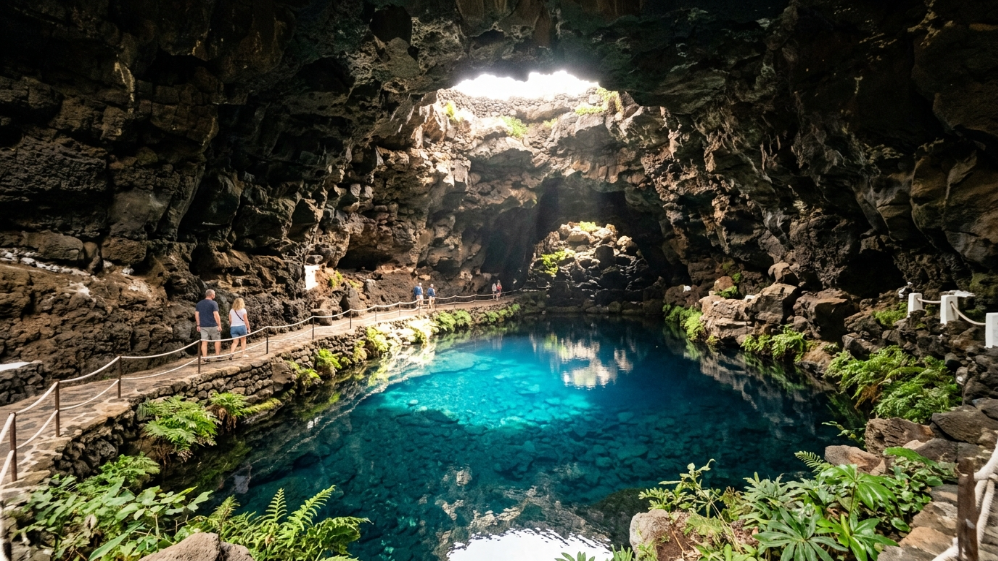
Over time, some sections of the roof collapsed. Each of those collapses — the openings that let the sky into the cave — is a jameo.
And there's more: the tube doesn't stop at the coast. It carries on for 1.5 kilometres under the ocean. It's called the Túnel de la Atlántida (Atlantis Tunnel), and it's one of the most remarkable underwater volcanic tubes in the world. You can see one of its entrances from the back of the restaurant.
Cueva de los Verdes is the same tube, 3 kilometres further along. Same volcano, same lava, two completely different ways of showing it off: over there, almost untouched; here, turned into art.
What you'll see at Jameos del Agua
Jameo Chico. You go down a staircase carved into the lava and the world changes. This is where you'll find the restaurant, tucked into a cavity of the tube, along with the hidden entrance to the Túnel de la Atlántida.
The blind crab lake. The heart of the place: a crystal-clear lagoon of filtered seawater where the jameíto (Munidopsis polymorpha) lives. It measures two or three centimetres, is albino and blind — it lives in total darkness — and is an endangered endemic species. Don't use flash: they're sensitive to light.
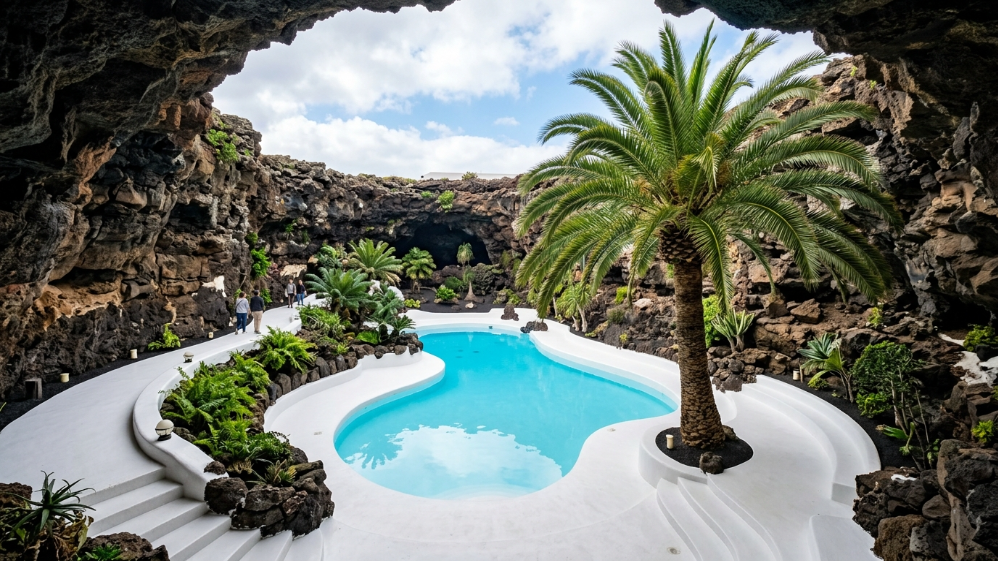
Jameo Grande. You come out into the open air and find the most photographed spot in Lanzarote: an impossibly white pool surrounded by garden, with a palm tree in the centre and lava walls all around. It's not for swimming — it's only been used on a handful of occasions — but it's the image you've been looking at ever since you first started dreaming about the island.
The auditorium. Inside the volcanic tube, with the rock itself as the wall. The lava absorbs some tones and reflects others, giving it genuinely extraordinary natural acoustics. Real concerts are held here.
Casa de los Volcanes. A volcanology museum within the site: the La Corona tube, the Geoparque Lanzarote y Archipiélago Chinijo (Lanzarote and Chinijo Archipelago Geopark) and the "planetary analogues" (landscapes here that resemble Mars). Note: it needs a separate ticket, combined with the Jameos ticket when you buy.
Jameo de la Cazuela. The third one, behind the auditorium stage, with waterfalls inside. Only seen on the premium guided tour (the Experiencia Insólita).
Practical tips
- Flat shoes with grip. There are stretches of wet rock and stairs. No flip-flops or heels.
- Bring a light jacket. Inside it's around 18-20°C whatever the weather's doing outside.
- You don't need to book a time slot (unlike Timanfaya or Cueva de los Verdes), but buying online saves you the queue.
- Free parking.
- On Fridays, the Noches de Jameos (Jameos Nights): a night-time visit, dinner and a concert next to the lake. It's a completely different experience, and probably the best time to see the place. (Check it's still on Fridays.)
- Allow 1 hour, or an hour and a half with the Casa de los Volcanes.
- Combine it with Cueva de los Verdes, just 3 km away, and with Mirador del Río.
What the CACT are (and the change you need to know about)
CACT stands for Centros de Arte, Cultura y Turismo (Art, Culture and Tourism Centres): the sites run by the Cabildo de Lanzarote, all designed or shaped by Manrique. There are seven:
Centre What it is Timed booking?
Montañas del Fuego (Timanfaya)The volcano and the Ruta de los VolcanesYes, compulsory onlineJameos del AguaThe volcanic tube turned into artNoCueva de los Verdes1 km of underground galleriesYes, compulsory onlineMirador del RíoThe island's best viewNoJardín de CactusManrique's last workNoMIAC – Castillo de San JoséContemporary art in a fortNoCasa-Museo del CampesinoA tribute to Lanzarote's farming lifeNo
⚠️ The combined pass no longer exists. The old CACT passes for 3, 4 or 6 centres, which used to save you a fair bit, were withdrawn by the Cabildo, and since then each centre is paid for separately. If you read elsewhere that "the pass is worth it", that article is out of date. There's no discount any more for visiting several.
Canary Islands residents and Lanzarote residents do get reduced rates, as do people with disabilities, but these only apply at the ticket office on presentation of ID.
some of Manrique's works aren't CACT sites and are paid for separately, because they're run by other organisations. The Fundación César Manrique (Tahíche) and the Casa-Museo de Haría are the two main ones. Don't go looking for them on the CACT website.
Which ones are worth it? Our take
Without a pass, the question isn't "do I see them all?" any more, it's "which ones?". Our honest answer:
Timanfaya. It's the one that's like nothing else in Europe. How to visit Timanfaya »
Timanfaya + Jameos del Agua. Fire and water, the raw volcano and the volcano turned into art. It's the whole island in two visits.
add Mirador del Río… if the day is clear. With mist you won't see a thing, and you'll have paid to look at fog. Safer alternative: Cueva de los Verdes.
the big five (Timanfaya, Jameos, Cueva, Mirador and Jardín de Cactus), split across two days: one day the south, another the north.
the MIAC is quick and in Arrecife, ideal for a spare afternoon or a rainy day; and the Casa-Museo del Campesino, in the middle of the island, is a brief stop on the way to anywhere.
Jardín de Cactus. People write it off thinking "it's just a cactus garden". And then they leave saying it was their favourite.
FAQs
What are Lanzarote's CACT?
Is there a pass for several centres?
Do you need to book a day and time?
Can you swim in the Jameos pool?
What is the jameíto?
How long does it take to see Jameos del Agua?
Does the ticket include the Casa de los Volcanes?
Are Jameos and Cueva de los Verdes the same thing?
Manrique was 47, with an international career behind him, when he came back to an island that had nothing. He climbed down into a hole in the ground, saw a pool with a little white creature in it… and decided it was a theatre, a garden and a lake, all at once.
The Jameos are proof of the idea that drove him his whole life: you don't need to bring beauty anywhere. It was already there. You just have to strip away what doesn't belong.