Twenty-five minutes by boat. That's all that separates Lanzarote from a place with no tarmac roads, where the streets are sand, there are no traffic lights and the beaches don't have so much as a beach bar.
La Graciosa is the eighth Canary Island — officially so since 2018, when it finally stopped being "a Lanzarote islet" and was recognised as an island in its own right. Around seven hundred people live there. No hotels. No hire cars. No rush.
This guide covers how to get there, what to do in a day, and the things worth knowing before you hop on the ferry.
How to get to La Graciosa
The ferry leaves from Órzola, at the northern tip of Lanzarote. It's about 25 minutes to Caleta de Sebo, the main village.
- Two ferry companies run the route, with departures roughly every hour in season, less often in winter. Timetables change: check them the day before.
- Rough price: around €25-30 return per adult.
- You can book online or buy at the ticket office on the quay.
- You don't need a car (forget it, in fact: you'd need special authorisation and it's just not worth it).
by car, it's about 40 minutes from Costa Teguise and over an hour from Playa Blanca. There is a guagua (local bus), but it only runs every one to two hours: if you're relying on it to get back, do the maths carefully or you'll be stranded. Getting around Lanzarote
The trick most people miss: it's the first and last sailings that matter most. Catch the first boat in the morning and the last one in the afternoon and you'll have the whole island to yourself. Go at midday and you'll just about have time for lunch and not much else.
And the serious warning: the sea between Órzola and Caleta de Sebo can get choppy. The crossing is short but rough, and strong winds can mean cancelled sailings. If you get seasick, take a tablet beforehand, sit at the back and keep your eyes on the horizon.
What exactly is La Graciosa
It sits within the Chinijo Archipelago Nature Reserve and is surrounded by the largest marine reserve in Europe. Alongside it are Montaña Clara, Alegranza and the uninhabited roques (rocky islets) of Este and Oeste — that's what you're looking at from the Mirador del Río down below.
Two settlements:
- Caleta de Sebo: the village. Seven hundred residents, sandy streets, white-and-blue houses, restaurants, shops and the harbour.
- Pedro Barba: a handful of houses to the northeast, mostly holiday homes. Absolute silence.
And that's it. Everything else is volcanoes, sand and sea.
Getting around the island
There are no tarmac roads. Just sandy tracks. You've got three options:
🚲 By bike — the classic choice. You can hire one in Caleta de Sebo as soon as you step off the boat. But be warned, because nobody tells you this: the tracks are loose sand, there are inclines, and the wind blows. There are stretches where you'll end up pushing the bike. If you can afford it, go electric: it changes the whole day.
🚙 By 4x4 taxi. They leave from the harbour and do routes around the main beaches. This is the option if you're travelling with kids, in the heat, or short on time.
🚶 On foot. Perfectly doable if you're happy sticking to La Francesa (about a 20-25 minute walk). For anywhere else, it starts to feel like a long slog.
Rough distances from Caleta de Sebo:
Destination Approx.
Playa La Francesa~2 kmPlaya de la Cocina~5 kmPedro Barba~5 kmPlaya de las Conchas~7 km
The beaches
La Francesa
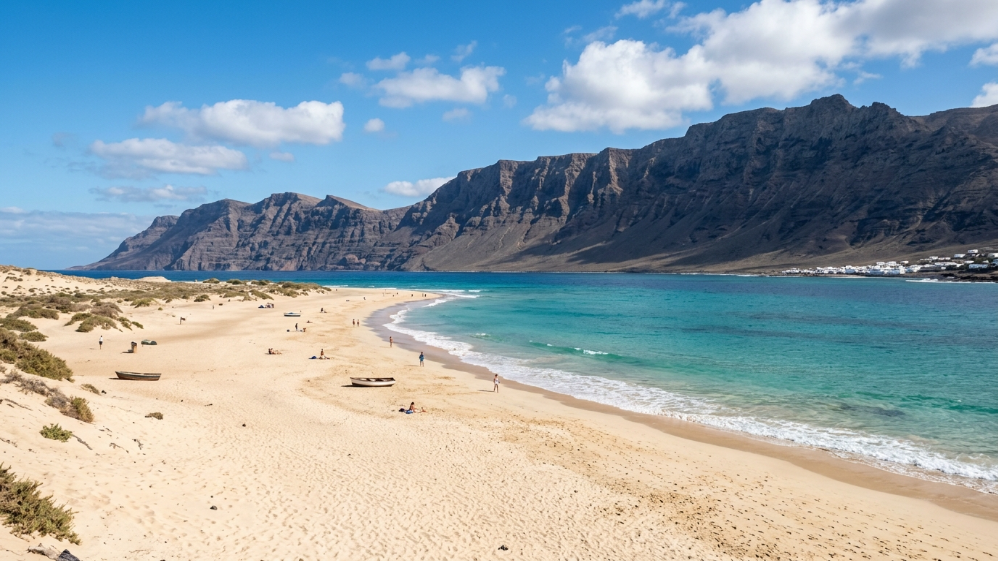
The closest and the most rewarding. Golden sand, calm, clear water, and opposite it, the Risco de Famara rising 600 metres above the sea. It's the postcard shot of La Graciosa and the beach where you actually go for a proper swim.
Playa de la Cocina
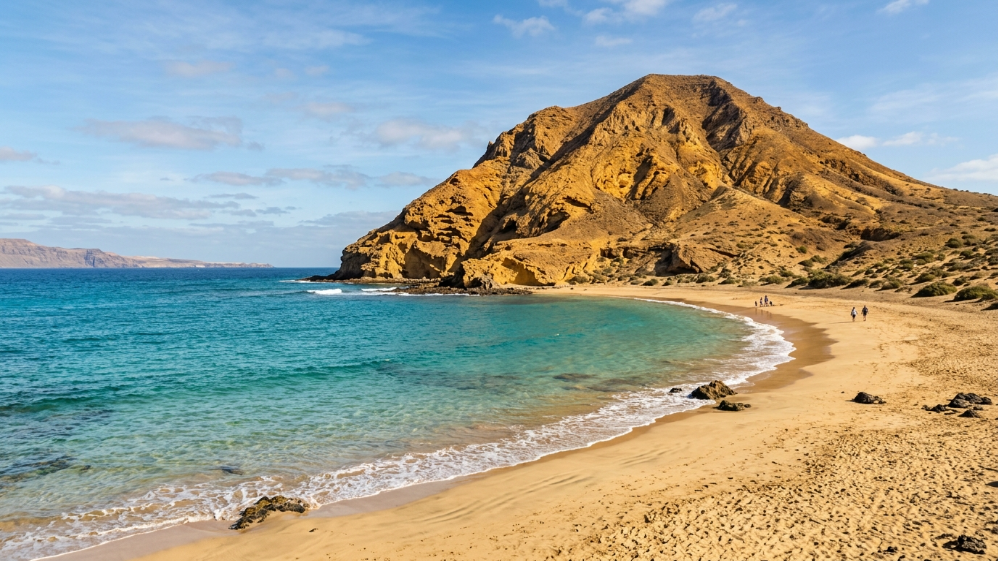
At the foot of Montaña Amarilla, an ochre volcano that drops straight into the water. Small, sheltered and the most photographed spot on the island. The contrast between the yellow and the turquoise doesn't look real.
Playa de las Conchas
To the north, facing Montaña Clara. It's the most spectacular of them all — pale sand, a good kilometre of it and nothing else, wind and open ocean.
⚠️ And it's also the most dangerous: the currents are very strong. This is a beach for looking, walking and taking photos. Not for swimming. Just because no one else is in the water doesn't mean it's fine — it's a warning.
The perfect day
Time Plan
8:00-9:00First ferry from Órzola9:30Hire a bike in Caleta de Sebo (or a 4x4 taxi)10:00Playa La Francesa: first swim, with Famara facing you12:00Playa de la Cocina and Montaña Amarilla14:00Lunch in Caleta de Sebo: fresh fish of the day16:00Las Conchas (to admire) or a second round at La Francesa18:00Last ferry, with the island turning gold behind you
If you're travelling with kids or it's scorching hot: a 4x4 taxi and two beaches. Don't try to do it all.
What to bring (this really matters)
- Water. Lots of it. Outside Caleta de Sebo there is absolutely nothing: no fountains, no bars, no shade.
- Food if you're spending the whole day away from the village.
- Sunscreen, a cap and sunglasses. There isn't a single patch of natural shade on the whole island.
- Cash. Services are few and basic: don't assume there's a cash machine or that everywhere takes cards.
- Footwear that can handle sand. Everything is sand.
- A windbreaker. Even on a sunny day: it blows here.
- A bag for your rubbish. There's no one here to pick it up for you. Whatever you bring in, you take back out.
Frequently asked questions
How do you get to La Graciosa?
How much does the ferry to La Graciosa cost?
Do you need to book ahead?
Can you take a car over?
How much time do you need?
Is cycling a good idea?
Can you swim there?
Are there hotels?
The strangest thing about La Graciosa isn't the beaches, or the colour of the water, or the volcanoes. It's the noise. Or rather: the lack of it. No engines, no tarmac, no traffic. You cycle along a sandy track and all you can hear is the wind and your own breathing.
Twenty-five minutes by boat. That's all that stands between your hotel and the quietest place in the Canaries.