Whenever you read about Lanzarote, the story always starts in the same place: 1730, with the volcano. Or 1966, with Manrique. As if nothing existed before that.
But before that, there were a thousand years of people. Men and women who crossed the Atlantic at some lost point in antiquity, settled on a volcanic rock with no rivers, and lived here for centuries, with goats, pottery and a language that nobody speaks anymore.
They called themselves —or we call them— the Majos. And their story is the part of Lanzarote that almost nowhere tells you about.
Who they were
The Majos (sometimes spelt Mahos) were the inhabitants of Lanzarote and Fuerteventura before the Europeans arrived. Their relatives on the other islands had different names — the Guanches, for instance, were the people of Tenerife, although that name is often used for all of them nowadays.
Where they came from: North Africa. The genetics, the language and the material culture all point to the Berber (Amazigh) world. When exactly they arrived is a different matter altogether: the dating has been revised several times and is still debated. What's certain is that it was centuries before the Christian era, and that by the time the Europeans turned up, around 1400, they'd already been here for a very long time.
And here's the puzzle nobody has ever fully solved: they arrived by sea… and then stopped sailing. By the time the conquistadors showed up, the Majos had no boats capable of reaching Fuerteventura, which you can see from the shore. They arrived on an island and stayed trapped there. Nobody knows for sure why.
the most repeated explanation is that it comes from "maho", the goatskin footwear they wore. It's a theory, not a fact. The same root supposedly gave rise to Majorata or Maxorata, the old name for Fuerteventura.
And the island wasn't called Lanzarote. It was called Titerogaka (or Titeroygatra, depending on the chronicle). The current name came later, and it came from outside: from Lancelotto Malocello, a Genoese sailor who turned up here around 1312 and stayed for about twenty years. An entire island that lost its name and ended up with that of a passing foreigner.
How to live for a thousand years on a rock with no water
No rivers. Barely any rain. No metals. No large trees. And yet:
- Goats, sheep and pigs. Livestock farming was the backbone. The goat —yes, the goat again— is the animal that explains this entire island.
- Barley and wheat, toasted and ground: gofio (toasted grain flour, still a local staple). What they ate is what you're still eating today. Traditional dishes of Lanzarote
- Hand-made pottery, with no wheel: the gánigos, dark vessels made from clay and picón (volcanic gravel).
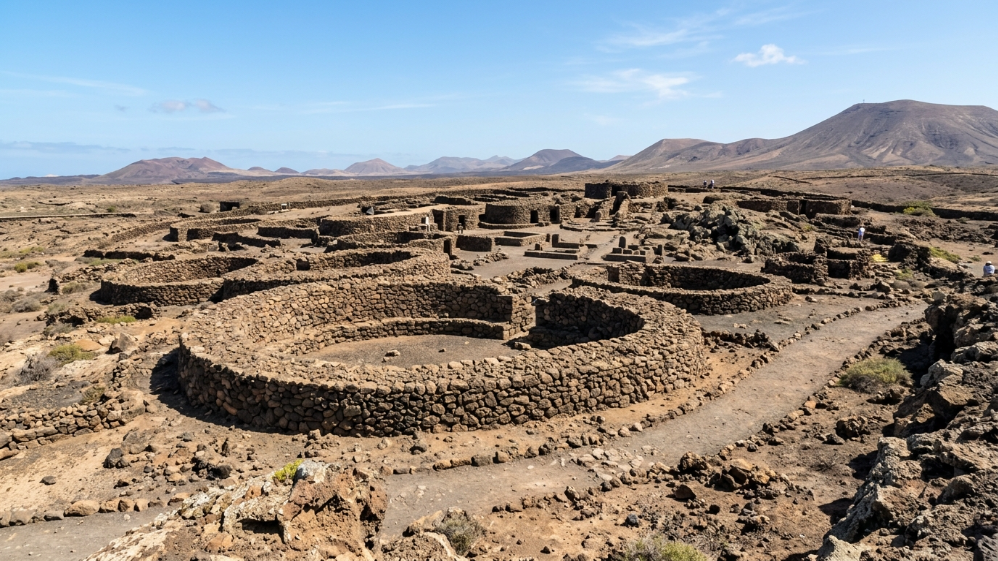
- Semi-buried houses made of dry stone, with thick walls to keep out the wind, and volcanic caves.
- Shellfish and fish from the shore: the concheros —shell middens piled up along the coast— are among the most abundant traces they left behind.
They lived in settlements. And they had a king: the chronicles mention a mencey, or chieftain, with his own court, his own place and his own rules.
Zonzamas: the "Palace" almost nobody visits
The Zonzamas archaeological site, in the centre of the island, was the main settlement: the seat of Majo power. And it's the only archaeological site in the Canaries known by the nickname "Palace".
What's there:
- The sunken houses: a settlement of semi-underground structures, partly surrounded by a stone wall. They dug downwards, not upwards: against the wind, against the heat, against everything.
- La Cueva de los Majos (the Majos' Cave), also known as the Palacio de Zonzamas.
- La quesera de Zonzamas ("the cheese rack"): a rock with carved channels, like a stone tray. The name is misleading —no cheese was ever made here— and the most widely accepted theory is that it served as a ritual space, for offerings. The truth is we simply don't know.
- La Peña del Letrero, with rock carvings that have been sitting there, watching, for centuries.
And here's the fact that sums it up: the archaeologists excavating it talk of 1,300 years of accumulated history on the same spot. Layer upon layer: the Majos, and on top of the Majos, everyone else.
You can visit, and it's free. The Cabildo (island council), together with the archaeology firm Tibicena, runs free guided tours with an archaeologist, in small groups (around 20-25 people) and by prior booking only. They're announced on the Cabildo's social media and booked through Tibicena's website. Spots go fast.
Check the current dates: they've changed over time (there have been weekday morning slots as well as weekend ones). And bear in mind: transport isn't included, you'll need to get there under your own steam.
this isn't Timanfaya. There's no bus, no shop, no audio guide. It's stones in a field. That's exactly why the guided tour changes everything: without someone explaining it, you see a wall; with them, you see a house.
the Cabildo is working on turning it into an archaeological park with an on-site museum. It's behind schedule, but it's happening.
there are also free guided tours to Fiquinineo (la Peña de las Cucharas), another archaeological site on the island.
The detail that changes everything
Near Teguise, at a spot called El Bebedero, fragments of Roman pottery have turned up. Amphorae. Here, on an island supposedly nobody ever visited.
What exactly it means is still up for debate: trade? An expedition? A shipwreck? But it points to something big: the Majos weren't as isolated as we thought. Someone from the Mediterranean reached this rock two thousand years ago, and then the world forgot about it for a thousand more.
The end: 1402
In the 14th century, Europeans started coming here for slaves. For decades, the island suffered raids: ships would arrive, take people away, and leave. By the time the conquest finally came, the population had already been decimated and worn down.
In 1402, the Norman Jean de Béthencourt —with Gadifer de La Salle, and with the blessing of the Crown of Castile— landed in the south of Lanzarote and founded Rubicón: the first European settlement in the Canaries, and from there, the first bishopric. The conquest of the Atlantic started here, on this island, and from here it moved on to the Americas.
The last Majo chief was called Guadarfía. He resisted, negotiated, got baptised, and eventually submitted.
And then came the thing that gives its name to this blog and to half the island: Teguise, Guadarfía's daughter, married Maciot de Béthencourt, the conqueror's nephew. Lanzarote's capital for four centuries carries the name of a Majo woman.
almost everything we know about these years comes from Le Canarien, the chronicle of the conquest. In other words: it was written by the winners. Read it with that in mind.
What's left of the Majos today
More than you'd think, if you know where to look:
- The place names. Timanfaya, Tinajo, Tahíche, Guatiza, Máguez, Yaiza, Femés, Guanapay, Zonzamas, Teguise… Lanzarote's map is written in a dead language. You drive through it every single day.
- Gofio. It's still on the menus. They ate it too.
- The goat. It's still the backbone of the local diet.
- The archaeological sites: Zonzamas, la Peña del Letrero, the queseras, the shell middens along the coast.
- The genetics. Studies show that today's Canarian population still carries a considerable North African genetic imprint. They didn't disappear: they blended in.
FAQs
Who were the Majos?
Are the Majos and the Guanches the same thing?
What was Lanzarote called before?
When did they arrive on the island?
Who was Guadarfía?
Can you visit the Zonzamas archaeological site?
Is it worth visiting without a guided tour?
Did the Majos disappear?
Tomorrow, when you drive towards Timanfaya through Tinajo, or head up to Máguez from Guatiza, remember this: you're speaking words from a language nobody speaks anymore.
The Majos didn't leave pyramids or cathedrals. They left something stranger: the name of almost everything you see. They've been silent for six hundred years, and they're still telling you where you are.