You've spent three days looking at lava. Black, ochre, red, black again. Ash all the way to the horizon. You've made your peace with the idea that this is just what Lanzarote looks like.
Then you head up north, round a bend… and the landscape turns green. Thousands of palm trees packed into a valley, orchards, fig trees, white houses tucked between terraces. It looks like a different island. Frankly, it looks like a different country.
That's Haría, and it's no accident that César Manrique chose this village to spend his last years — the man who'd seen every corner of the island decided to end up here. This guide covers what to see in Haría, why it's green, and how to make the most of the north.
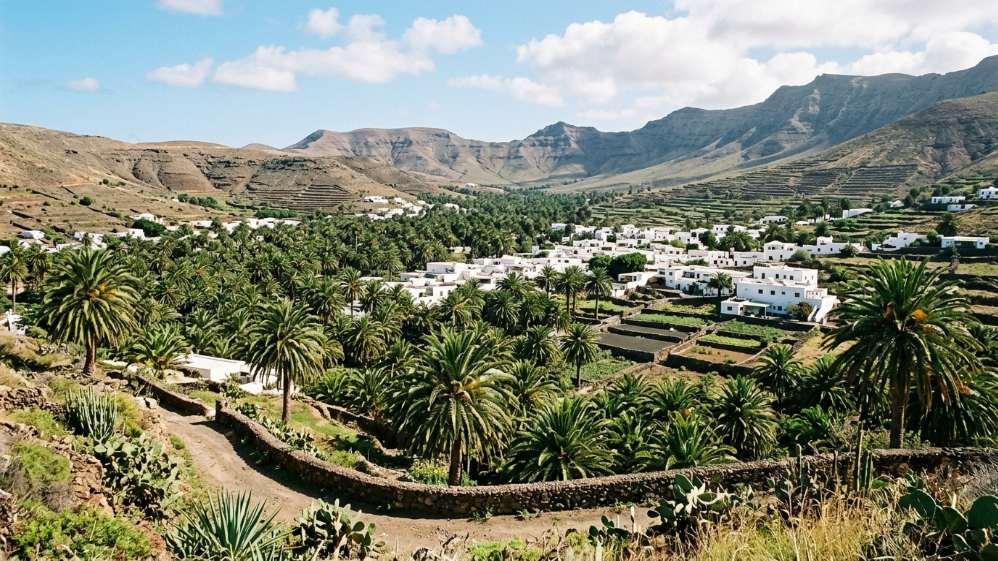
Why the north is green
It's not magic, it's geography. The Famara massif, that 600-metre wall dropping into the sea, blocks the moisture-laden trade winds (alisios) coming off the Atlantic. The clouds hit it, rise, cool down and dump what little rain Lanzarote gets right here.
The result: the north has more water, more cloud cover, more soil and less heat than the rest of the island. Real farming happened here while the south was still a desert of ash — which is why this valley has been settled and worked for centuries.
And then there are the palms. Local tradition in Haría apparently had it that a palm tree was planted when a boy was born, and two when a girl was born, the latter as part of her dowry. Hence the name Valley of a Thousand Palms. These are Canary Island palms (Phoenix canariensis), the native species — not the ones decorating hotel lobbies.
Count them if you fancy it. There are well over a thousand.
What to see in Haría
The village
Small, white, with a square — Plaza León y Castillo — shaded by huge Indian laurels, where everything happens. Four streets, whitewashed houses with green woodwork, a couple of terraces, and a quiet that feels strange after Puerto del Carmen.
There are no "sights" as such. Haría isn't a place you visit, it's a place you wander through. Half an hour and you'll have seen it all.
The Casa-Museo César Manrique
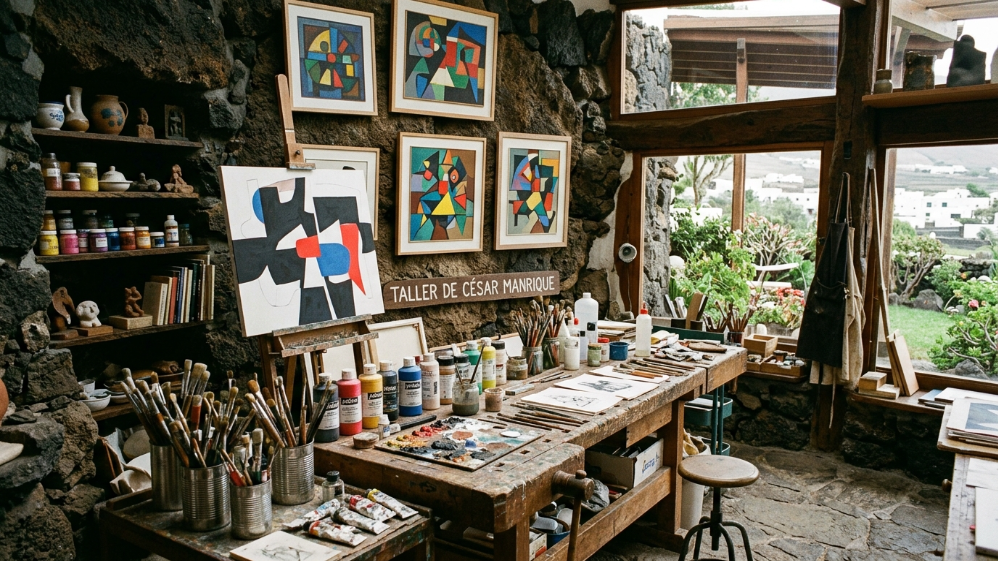
The village's must-see, and the most intimate of all his houses. This was his final home, an old farmhouse in the valley that he restored to retire to, away from the fuss he himself had helped create.
It's kept exactly as it was the day he died: his studio with half-used brushes, unfinished paintings, his belongings, his clutter. It's not a curated museum — it's a house where someone lived and one day left, never to return. He's buried in Haría's cemetery, just a stone's throw away.
this isn't one of the CACT sites. You pay separately, and you won't find it listed on the Cabildo's official visitor centres website.
The Saturday craft market
On Saturday mornings (roughly 10am to 2.30pm), the square fills with stalls. And here's the difference with Teguise: this one is small, and it's genuine. Local crafts, cheeses, jams, aloe vera, embroidery, actual villagers. No coach parties, no crowds, no imported tat by the truckload.
If we had to pick one, for shopping we'd go for Haría; for atmosphere, Teguise.
The Mirador de Haría
On the road up from Teguise (LZ-201), a bend opens up and there it is: the whole valley laid out below you, palm trees, white houses and mountains all around. It's one of the loveliest stops on the island, it's free, and plenty of people just drive past it.
stop off at the Ermita de las Nieves too, a bit further along, right at the top of the cliff. From there you get Famara from above, a balcony over thin air. On a clear day, it's one of the best views in Lanzarote.
The rest of the north (which starts right here)
Haría is the gateway. Within fifteen minutes you've got the best the island has to offer:
- Mirador del Río (15 min): the view of La Graciosa from 500 metres up. Guide to the Mirador del Río »
- Jameos del Agua and Cueva de los Verdes (15 min): the La Corona lava tube. Jameos del Agua and the CACT sites »
- Órzola (15 min): the ferry to La Graciosa and the Caletón Blanco, with its white-sand pools set among lava. La Graciosa in a day »
- Punta Mujeres and Arrieta (10 min): natural rock pools and fresh fish right by the sea.
- Máguez, Yé, Tabayesco: the surrounding villages, where there's absolutely nothing to do. Which is exactly the point.
For walking
The north is the island's best area for hiking: the La Corona volcano (the one that created the Jameos tube) can be climbed from the villages above, and the Camino de los Gracioseros runs down from the cliff edge — the path locals from La Graciosa used to walk down to catch the boat. The routes here are green and full of views, not a barren field of lava.
Practical tips
- You need a car, full stop. There's a guagua (bus) to Haría from Arrecife, but it only runs every one or two hours. Getting around Lanzarote »
- The road from Teguise (LZ-201) is winding. Lovely, but winding — if anyone gets carsick, you've been warned.
- Bring a light jacket. It's a few degrees cooler here than in the south, and windier too. In winter, you'll really feel it.
- Watch out for mist: the northern viewpoints cloud over easily. If it's overcast when you wake up, switch the plan to Manrique's house, the Cueva de los Verdes or the wineries. Best time to visit Lanzarote »
- A one-day plan: Haría and its valley → Manrique's house → lunch in Arrieta → Jameos → Mirador del Río at sunset. The perfect 3-day itinerary »
Where to stay and eat in the north
Haría has terraces on the square and good old-fashioned Canarian cooking; Arrieta and Punta Mujeres offer fresh fish ten minutes away. Don't expect a tasting menu — expect grilled cheese, catch of the day, and papas arrugadas (wrinkled potatoes) with mojo (Canarian sauce).
And if you're thinking about staying here — stone houses among the palms, zero noise, the best starry sky on the island — know what that means: you're 40 minutes from the airport and over an hour from Papagayo. This is the area for people who already know Lanzarote and have come back for something different.
FAQs
What is there to see in Haría?
Why is Haría green when Lanzarote is a desert?
When is the Haría market on?
Why is it called the Valley of a Thousand Palms?
Is the Manrique Casa-Museo in Haría worth visiting?
How long does it take to see Haría?
Can you get there without a car?
Manrique could have retired anywhere in the world. He'd lived in Madrid and New York, he had galleries, money, a name. And he chose a village of a thousand people tucked into a valley of palm trees, at the furthest tip of his own island.
When you drive down the LZ-201 and see the valley open up below you, you'll understand why without anyone needing to explain it.