Picture a desert of black ash, without a drop of rain for months, with the Atlantic wind blowing non-stop. Now picture one of the world's most singular white wines coming out of it. That's La Geria: not just a pretty vineyard, but an entire island's answer to catastrophe.
When the volcano buried a third of Lanzarote between 1730 and 1736, farmers discovered something unexpected: beneath the blanket of ash, the soil was still alive. And instead of giving up, they invented a way of growing vines that doesn't exist anywhere else on the planet. In this guide we'll tell you what La Geria wine actually is, why Lanzarote's vines grow inside pits, which wineries to visit, and how to plan your wine-tourism day without getting it wrong.
Tip before you start: La Geria is explored along the LZ-30 road, between Uga and Mozaga. Public transport barely reaches here and the wineries are spread out. You need a car… and a driver who isn't tasting. We explain it all in the guide to getting around Lanzarote.
Why Lanzarote's vines grow inside a pit
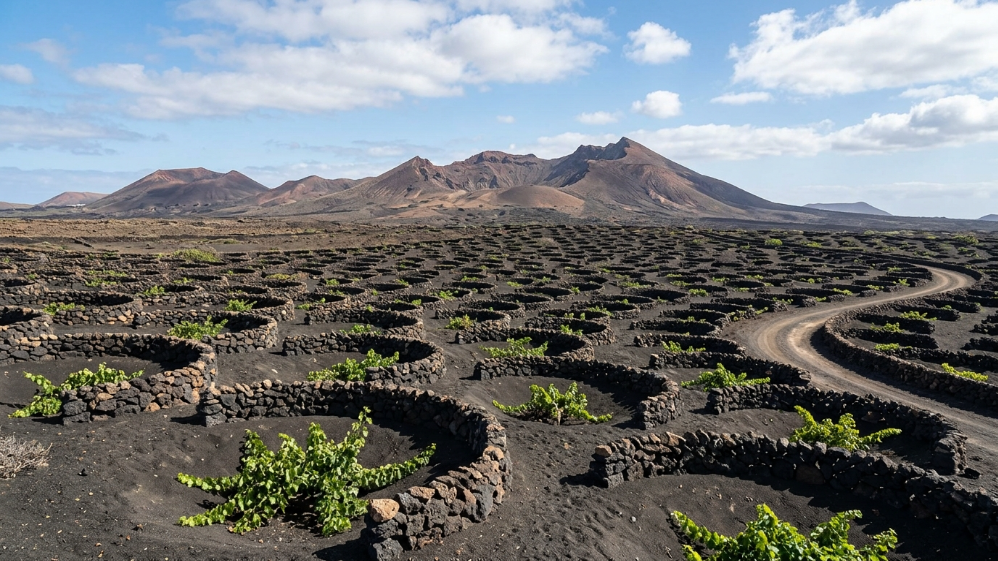
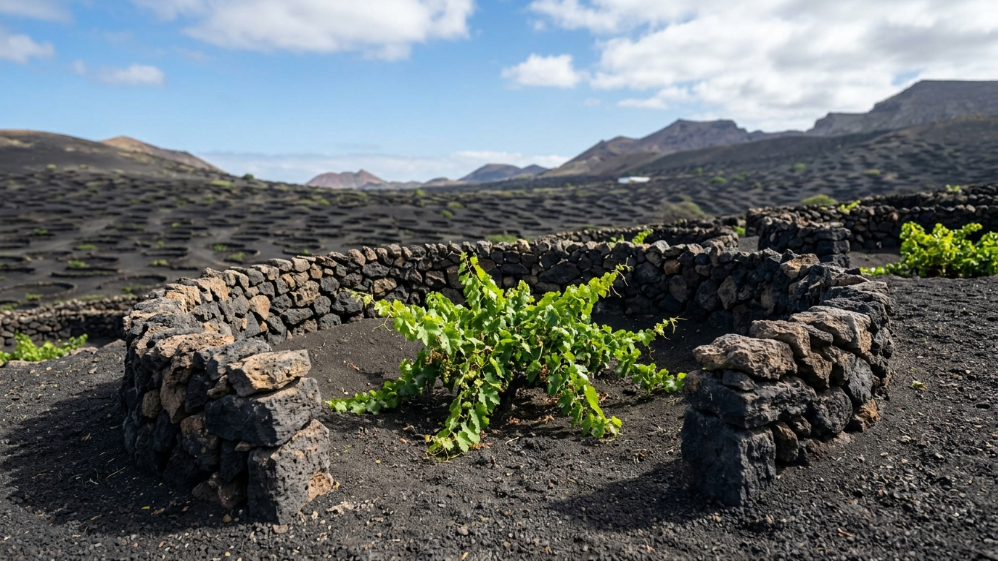
There are no rows or trellises here. There are thousands of craters dug by hand into the picón (the volcanic ash), each with a single vine at the bottom and a crescent-shaped stone wall — the zoco — sheltering it from the alisio (trade wind). Seen from the road, La Geria looks like a lunar landscape dotted with green polka dots. Geographers call it accidental land art; the locals just call it work.
The system, known as enarenado (natural ash-mulching), works for three reasons:
- The picón traps moisture. The ash absorbs the night-time dew and filters it down to the root, which reaches down to the fertile soil buried below. On an island with less than 150 mm of rain a year, this is what makes the vineyard possible.
- The pit shields the vine from the wind. The alisio blows constantly; without the zoco, the plant wouldn't survive.
- The ash keeps weeds and pests at bay. Phylloxera, which devastated Europe in the 19th century, never reached Lanzarote. That's why there are century-old, ungrafted vines here, growing on their own roots: a treasure that's almost disappeared from the mainland.
The price of all this is labour: everything is done by hand, vine by vine, and a hectare in La Geria yields a fraction of what a hectare on the mainland does. Hence the name it's known by in the wine world: heroic viticulture.
the Paisaje Protegido de La Geria covers around 5,200 hectares spread across several municipalities, and is a recurring candidate for World Heritage status. When you pull over on the verge for a photo, you're looking at a crop that's officially been declared a landscape.
Malvasía Volcánica and La Geria's other wines
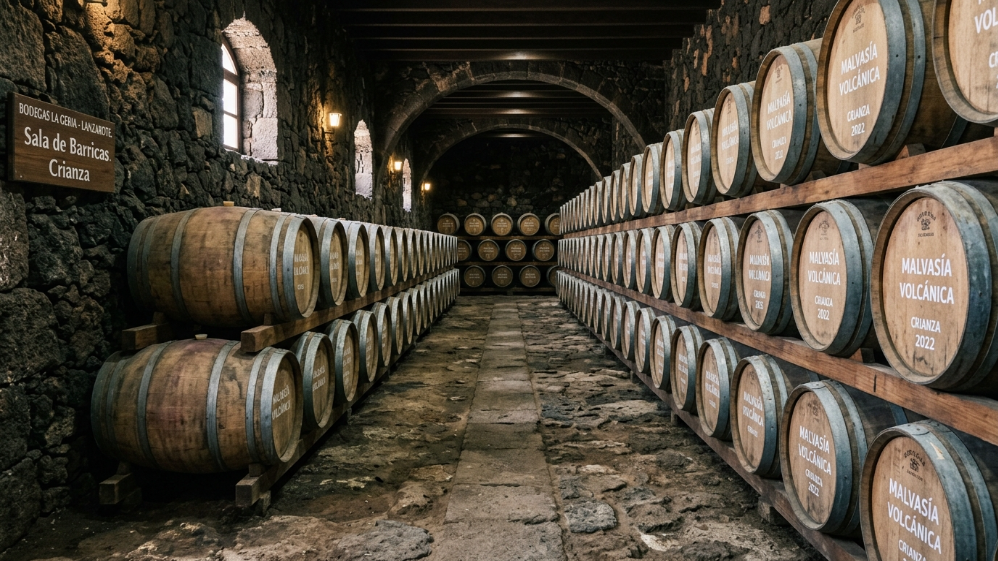
The star is Malvasía Volcánica, a native variety (a natural cross between aromatic malvasía and marmajuelo) grown only here. It produces a white wine that's aromatic but dry and crisp, with notes of white fruit, herbs, and that saline, mineral edge that gives away the picón. Nothing like the sweet malvasía you might be picturing.
But the range on offer is broader than people expect:
Variety What to expect
Malvasía VolcánicaDry, aromatic, mineral white. The island's signature wine.Diego (Vijariego)Light, fresh white, very easy to drink.MoscatelSweet and naturally sweet wines. Good with dessert and cured cheese.Listán NegroThe local red. Light, with a smoky volcanic touch.NegramollFruity reds and rosés.
And two curiosities worth seeking out: the carbonic maceration reds (young, moreish, almost like a volcanic Beaujolais) and the sparkling wines now being made by several of the island's wineries.
It's all protected under the DO Vinos de Lanzarote, created in 1993. And here's a detail that surprises everyone: this is where Europe's earliest grape harvest takes place, between late July and August. Come in summer and you'll see camels and tractors hauling grapes.
if you're only taking home one bottle, make it a dry Malvasía Volcánica. It's the one that tells the island's story best, and the one you won't find in your local supermarket. Many restaurants in Lanzarote serve it by the glass: taste before you buy.
Which wineries to visit in La Geria (and how to choose)
There are around twenty wineries open to the public on the island. Don't try to see them all: two in one morning is plenty. Here are the ones that work best depending on what you're after.
El Grifo — the most historic
Founded in 1775, it's the oldest working winery in the Canaries and one of the oldest still operating in Spain. Besides the tasting, it has a wine museum with original presses and tools, plus a wine library. Its logo, the mythological griffin, was redesigned by César Manrique: the island, once again, passing through his hands.
anyone who wants to understand the history, not just drink. Ideal if it's raining or too hot outside.
Bodega La Geria — the postcard view
Right in the heart of the valley, with the Montañas del Fuego of Timanfaya in the background. It's the most visited winery on the island (and one of the most visited in Spain), which has its upsides — daily guided tours in Spanish and English — and its downsides: in high season it can fill up with coach parties.
anyone after the photo and a simple, no-fuss tasting. Go first thing in the morning.
Bodegas Rubicón — the sunset terrace
Right opposite, on an 18th-century estate. Hillside vineyards, a tasting terrace looking out at the volcano, and its own restaurant. This is the option for staying a while, not just passing through.
sunset, couples, an unhurried tasting. Book ahead in high season.
Stratvs — the most contemporary
Minimalist architecture blended into the landscape, and a carefully curated tour of the winemaking process. The most "modern winery" experience in the valley.
anyone who already knows their wine and wants to see the technical side.
Vega de Yuco (Finca Testeina) — the experience
Vineyards at the foot of the Testeina volcano, with guided tastings that usually include a pairing (local cheeses, artisan chocolate). One of the best-rated options for anyone after a guided experience lasting a couple of hours.
anyone who wants it explained properly and isn't in a rush.
Outside the valley, but essential
- Los Bermejos (El Islote, near San Bartolomé): probably the island's most award-winning wines. Its carbonic maceration reds and sparkling wines are the reason to go.
- Vulcano de Lanzarote (Tías): an urban, organic winery just a stone's throw from Puerto del Carmen. The perfect option if you're staying in the south and don't want to drive far.
How to plan your wine route: the practicalities
The road. The LZ-30 crosses the valley between Uga (south) and Mozaga (north). You can drive it either way; the scenery is just as spectacular. There are designated viewpoints and laybys: don't stop just anywhere, the road is narrow and winding.
Time needed. Allow 2–3 hours for the full route with stops at two wineries. Half a day if you add lunch.
Money. Driving through the valley is free. Tastings range, roughly, from around €10–15 per person (visit + basic tasting) up to €20–50 for premium experiences with food pairings. Always check each winery's website: prices and opening times change with the season.
Booking. In high season, and for guided tours, book ahead. Groups are limited in size, and the bigger wineries work with coach parties.
Timing. Early morning to avoid the tour groups; late afternoon for the light. Midday, with the sun directly overhead, is the worst time for photos and the best time to eat.
The driver. Obvious but necessary: someone isn't tasting. If everyone in your group wants to taste, there are half-day excursions with transport included from the main tourist resorts (roughly €40–55 per person).
What to combine it with. La Geria sits right next to Timanfaya, Yaiza and the Salinas de Janubio. It's the natural backbone of a day out in the south of the island.
When to go: the wine calendar
- July–August: Europe's earliest grape harvest. Seeing the grapes brought into the winery — sometimes still by camel — makes this the best time of year to visit.
- August: the Fiesta de la Vendimia (Grape Harvest Festival) in La Geria, with grape-treading, music and tastings. Check the dates for the current year.
- January: pruning season and the Fiesta de San Antonio Abad, closely tied to Lanzarote's rural traditions.
- Spring: the vines bud and the pits fill with green. The contrast with the black picón is at its most striking.
- All year round: the wineries are always open. There's no bad time to come, just different ones.
More details in our guide to the best time to visit Lanzarote.
Where to eat and stay near La Geria
La Geria wine calls for a table. In the valley itself and in nearby villages — Uga, Yaiza, Masdache, San Bartolomé — you'll find everything from wineries with their own restaurants to classic Canarian cooking: papas arrugadas (wrinkly salt-baked potatoes) with mojo (a Canarian sauce), grilled goat's cheese, and the famous smoked salmon from Uga. Pick your spot on LanzaEat, our directory of restaurants, bars and guachinches (rustic, home-style eateries) in Lanzarote, and look for the ones with a good list of island wines.
And if you fancy waking up surrounded by vines, the centre of the island is full of country estates and rural houses with volcanic stone walls, many just ten minutes from La Geria. On LanzaStay we've brought together villas, fincas and apartments you can book directly with the owner: it's the way to experience this part of Lanzarote from the inside, rather than from a beach hotel.
Frequently asked questions
Can you visit La Geria for free?
Do you need to book a winery visit in advance?
How long does it take to explore La Geria?
Can you get there without a car?
Which Lanzarote wine should I buy?
Is it suitable for visiting with kids?
You don't visit a vineyard in La Geria: you visit an idea. The idea of an island that, buried under ash, decided to plant right there anyway. Every one of those thousands of pits was dug by hand by someone who knew it would yield little. That's why, when you raise your glass looking out over the valley, the wine will taste of something more than fruit.
Have you already tried a Malvasía Volcánica? Which one surprised you the most? 👇
Updated on July 17, 2026 · Published on July 14, 2026