Down here, at thirteen metres, the ground is at 610 degrees.
That's not a brochure figure: it's the measurement taken by Spain's Geological and Mining Institute. That's why, when a guide throws a handful of dry brushwood into a hole, it bursts into flames on its own within three seconds. And when they pour a bucket of water into a buried pipe, a geyser of steam shoots out and hits you in the face.
Three hundred years after the eruption, Timanfaya is still hot. And that's what you've come to see.
This guide has everything you need for your 2026 visit — starting with the change that's catching people out: tickets are no longer sold at the gate.
The essentials: 🎟️ €30 adults · €15 children 7-12 · free under 7s · 🕘 9am to 5pm · ⚠️ compulsory online booking with a time slot · ⏱️ allow 2 hours
 ⚠️ First things first: booking is compulsory
From 15 June 2026, tickets are no longer sold at the gate. Not a single one. If you turn up without a booking, you don't get in — it doesn't matter if there's space, if it's low season, or if you've driven an hour to get there.
How it works:
- Buy on the official CACT website (cactlanzarote.com). It's the only official source.
- Choose a day and time slot. The daily capacity is limited, and in high season it sells out days in advance.
- Download the ticket to your phone before you set off. This isn't a minor tip: the signal there is poor, and more than one visitor has been stuck at the gate trying to open their email.
- Arrive 15 minutes before your slot.
And an honest warning almost nobody gives you: having a ticket doesn't guarantee you'll get straight in. There can be a queue of cars at the entrance, and a queue for the bus too. Booking secures your place for the day, not that you won't wait.
2026 prices
- Adults — €30
- Children aged 7 to 12 — €15
- Under 7s — free
parking, the geothermal demonstrations at the Islote de Hilario, and the bus ride along the Route of the Volcanoes. All of it together: there's nothing else to pay inside.
💡 The CACT combined pass no longer exists. It used to be a discounted pass covering several sites; now each one is paid for separately. If you were planning to see Timanfaya, Jameos, Cueva de los Verdes and Mirador del Río, do the maths beforehand: for two people it comes to around €200.
Jameos del Agua and the CACT: which ones are worth it · Budget for a week in Lanzarote
9am to 5pm, every day. The Mancha Blanca Visitor Centre keeps the same hours and is free.
What happened here: Spain's longest eruption
On 1 September 1730, the ground opened up near Timanfaya. It wasn't a single eruption: it was six years of intermittent eruptions, right up until 16 April 1736. It's the longest recorded historical eruption on Spanish soil.
What it left behind:
- 51 km² buried under lava and ash — almost a quarter of the island.
- More than 30 villages and hamlets buried. Entire settlements, with their houses and wells, are still down there.
- A third of Lanzarote's best farmland, lost forever.
- And here's a surprising fact: not a single death. The lava moved slowly enough for people to escape. Many emigrated to the Americas and never came back.
Oddly enough, that catastrophe produced almost everything that makes this island special today: the wine of La Geria grows in pits dug into that same ash, and the Janubio salt flats exist because the lava sealed off a lagoon.
Why it's still hot after 300 years
This is the question everyone asks when they see the brushwood catch fire, and hardly anywhere answers it properly.
It's not cooling lava. The 1730 lava cooled long ago. What's underneath is something else: a residual magma chamber, a pocket of molten rock trapped at between 2 and 4 kilometres deep. It's still there, and it's still hot.
That heat rises through the cracks in the ground. The official readings:
- At the surface: 100-120°C (up to 250°C at some points)
- At 13 metres deep: 610°C
That's why Timanfaya isn't a fossilised museum. It's a sleeping volcano with a warm hand — and the highest thermal anomalies in the whole of the Canaries are right beneath your feet.
Islote de Hilario: what it is and where the name comes from
The spot where the visit stops has its own story, and it's a double one.
the Islote de Hilario is a kipuka — a patch of older ground that the lava surrounded without covering, left standing like an island in a sea of stone. It rises above the malpaís (badlands), which is why it was possible to build there.
tradition says it's named after Hilario, a Lanzarote man who came back from the war in the Philippines and decided to settle right here, in the most inhospitable spot on the island. He lived more than fifty years as a hermit in the middle of the malpaís, with no company but his camel.
Think about that for a moment when you're up there, surrounded by the café, the car park and the buses: someone lived half a century here, alone, on ground hot enough to burn.
What the visit involves, step by step
1. The geothermal demonstrations
Right after you arrive at the Islote de Hilario. There are three, they take a few minutes each, and they're included in the ticket price:
- The self-igniting brushwood. They push some dry branches into a shallow hole and they catch fire within seconds, with nothing else applied.
- The artificial geyser. They pour a bucket of cold water into a metal pipe driven into the ground. Within seconds, a column of steam shoots out.
- The hot stones. They let you touch the surface gravel so you can feel for yourself that it really is burning hot.
Kids go wild for it. It's the best part of the visit for them. Lanzarote with children
2. The Route of the Volcanoes
Around 35-40 minutes by bus, along a road closed to private traffic. Nobody can drive it themselves: it's the only way into the heart of the park.
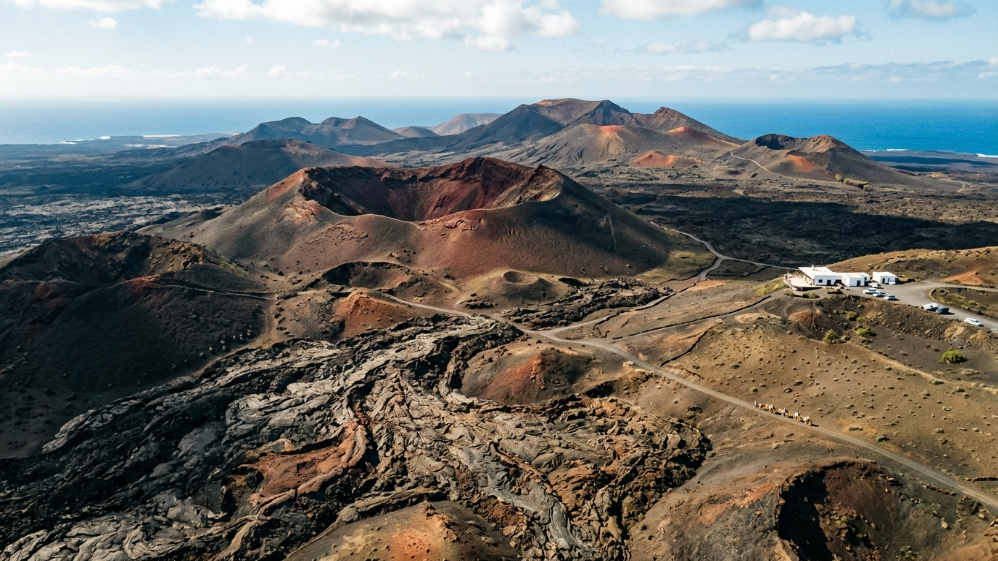
The route passes the Montaña Rajada, the Caldera del Corazoncillo, the Volcán del Chinero and the Calderas Quemadas, with photo stops and commentary in several languages.
the scenery. Black craters, red and ochre lava flows, shapes you won't see anywhere else in Europe.
you don't get off the bus. Everything is seen through the window. It can feel long for small children, and if you were hoping to walk over the lava, this isn't it. Keep reading for that.
sit on the right-hand side. It has the better views for most of the route.
3. The El Diablo restaurant
At the top of the islet, a work by César Manrique — designed with Eduardo Cáceres in 1966, opened in 1970. A circular building with floor-to-ceiling windows and a sea of lava all around.
And at its centre, the grill: a grate over an open pit where meat is cooked using the heat of the ground. No gas, no coals, no electricity. At six metres down there's around 400°C, and that's what they cook with.
It was a serious engineering challenge: building a restaurant on ground hot enough to burn. Manrique solved it, and the result is one of the most ingenious things on the island.
a set menu at around €25-35 per person. Book ahead, especially for lunch.
pop in anyway to see the grill and the windows. Worth it even for just a coffee.
4. The Mancha Blanca Visitor Centre
Free, about 7 km from the park entrance. This is where you really get to grips with what happened: exhibits on the 1730-1736 eruptions, models, a seismic room and an eruption simulator.
Plenty of people understand it better here than at the Islote de Hilario itself. If you're travelling with kids or you're into geology, come before entering the park: the visit afterwards is twice as enjoyable.
The walking trails: what almost nobody knows
Inside the National Park you can't walk freely on your own. But there are two guided trails, and they're free:
Tremesana Trail
Around 3-4 km · about 3 hours · guided · free
It's the only legal way to set foot on the 1730 lava. Led by a park guide, in very small groups, Monday to Friday.
places are extremely limited and you need to book two or three weeks ahead at the Mancha Blanca Visitor Centre. They fill up fast.
If you're genuinely into volcanic landscapes, this is worth far more than the bus ride. No comparison.
Litoral Trail
Around 9 km, along the park's coastline. Check with the Visitor Centre on the current status: it's switched between guided and self-guided over time.
And the free alternative, no booking needed
If you can't get a place — or don't want to pay the €30 — there's an option very few people know about:
Caldera Blanca. A roughly 10 km trail starting from Mancha Blanca, outside the park, crossing the 1730 lava field and climbing to the rim of a huge crater. From the top you get the best panoramic view of Timanfaya you can find… and it's free, no booking, no bus.
The camels: let's be honest
At the echadero (camel station), a few kilometres from the entrance, camel rides are on offer. They're paid separately: not included in the ticket price.
camels aren't a tourist gimmick. They were brought to the island because their broad, padded feet work like skis on loose ash — they don't sink where a horse or donkey would. They were this island's tractors: they ploughed the vineyards of La Geria, built walls and hauled everything that needed hauling. Without them, Lanzarote wouldn't have recovered.
more and more visitors are choosing not to ride, because of the conditions the animals work in. Some see it as living heritage; others see it as animal cruelty.
We're giving you the facts. The decision is yours.
How to avoid the queues
Here's the specific detail: at 9.30am you walk straight in. By 11.30am there can be up to a 90-minute wait for cars at the entrance.
What works:
- Take the first time slot of the day. Best tip in this whole guide.
- Avoid 11am to 2pm. That's when all the organised hotel excursions turn up.
- In summer, Easter and Christmas, book weeks ahead.
- The last slot of the afternoon tends to be quiet too, and the light is better for photos.
- If there's calima (Saharan dust haze) or strong wind, consider changing your day: you lose a good part of the scenery.
How to get there
It's between Yaiza and Tinajo, in the south-west of the island, on the LZ-67 road.
- Playa Blanca: 25 min
- Puerto del Carmen: 30 min
- Arrecife: 35 min
- Costa Teguise: 45 min
- Órzola (north): 1 hr
You'll need a car. There's no public bus that reaches the park: only organised excursions. Getting around Lanzarote
Parking is included in the ticket price.
What to bring
- Your ticket downloaded to your phone. Worth repeating: the signal drops out.
- Water. There's no shade anywhere on the visit.
- Cap and sunscreen. The sun is strong and the black rock radiates heat back at you.
- A windbreaker. Even when it's warm: it's windy up there.
- Closed shoes. No flip-flops.
- A charged camera. You'll take more photos than you expect.
How to fit it into your day
Timanfaya takes about 2 hours to see. What works best:
Timanfaya first thing → La Geria mid-morning, with a wine tasting → lunch among the vines. Afternoon: El Golfo and the Charco de los Clicos → Los Hervideros → sunset at the Janubio salt flats.
As far as we're concerned, that's the best day out in southern Lanzarote.
FAQs
How much does a Timanfaya ticket cost in 2026?
Do you need to book Timanfaya in advance?
What are Timanfaya National Park's opening hours?
How long do you need to visit Timanfaya?
What's included in the ticket?
Can you drive through Timanfaya in your own car?
Can you walk around Timanfaya?
Why is the ground at Timanfaya still hot?
Is it dangerous? Could it erupt again?
Is Timanfaya worth it with kids?
What's the best time to visit Timanfaya?
What is the Islote de Hilario?
How does the El Diablo restaurant cook its food?
Do you need to book at El Diablo?
Does the CACT combined pass still exist?
Can you get to Timanfaya by public transport?
When did the Timanfaya eruption happen?
Did anyone die in the eruption?
Are there any animals in Timanfaya?
What happens if I'm late for my time slot?
Is it worth it in bad weather?
And if you can only do one thing in Lanzarote
Make it this.
Timanfaya is like nothing else you'll have seen. It's not a pretty mountain or a scenic viewpoint: it's the exact spot where an island broke apart and kept burning inside for three hundred years.
Beneath your feet, thirteen metres down, there's rock at over six hundred degrees. And two kilometres down, a pocket of magma that's been there since long before anyone ever set foot on this island.
There's nothing to do with that except stand and stare. Which is quite something in itself.
Have you already been? What time did you go, and did you get stuck in a queue? Let us know — it helps the next person 👇
Updated on July 28, 2026 · Published on July 16, 2026