On 25 September 1992, César Manrique left his foundation in Tahíche, entered the roundabout next door, and died in a car accident. He was 73. He'd spent twenty-five years fighting to stop Lanzarote turning into what everywhere else had become.
And here's the incredible part: he won.
If you're wondering why Lanzarote has no skyscrapers, no billboards, no neon signs, no overhead cables, not a single building painted any colour other than white — the answer is one man. This guide covers who César Manrique was, why the entire island is his work, and which are his must-see pieces, with a route to see them all in a day.
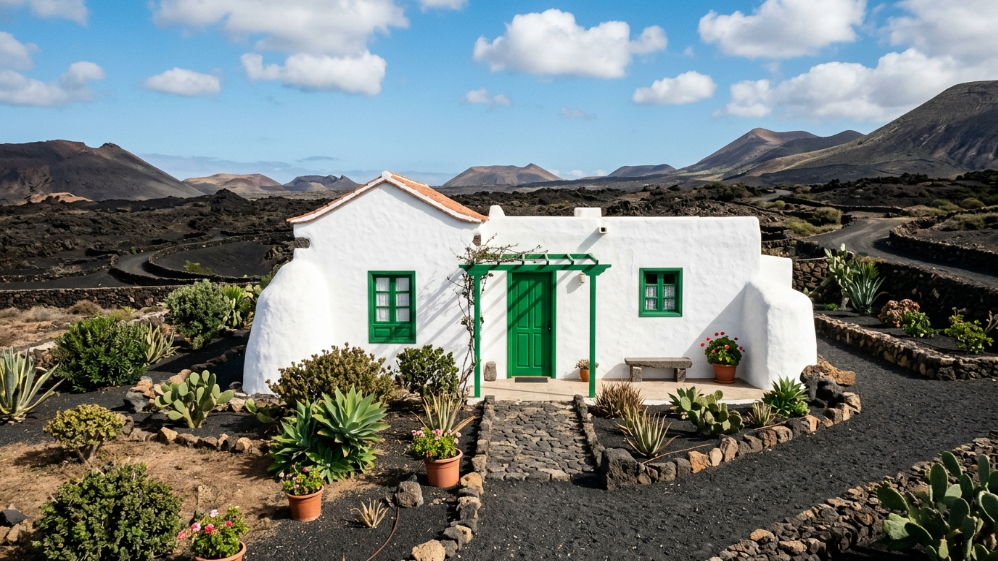
Who César Manrique was
He was born in Arrecife in 1919, the son of a poor, forgotten island that lived off the sea and salt. He studied Fine Art in Madrid, and did well: by the fifties he was already a recognised abstract painter, the kind who exhibited outside Spain.
And then he went to New York. Two years, in the mid-sixties, right at the epicentre of the art world, with a gallery, contacts, and a Rockefeller as his patron. Most people would have stayed.
Manrique came back to Lanzarote in 1966. To an island with no running water, hardly any roads, no tourism. And he came back with an idea that sounded like madness at the time: that art and nature could be the same thing, and that Lanzarote — ugly, black, dry, the island everyone wanted to leave — was the most spectacular work of art he'd ever seen.
«Lanzarote is an unfinished work of art, and the landscape is its raw material.»
In New York he'd seen the future: skyscrapers, concrete, speculation. He came back knowing exactly what he needed to save his island from.
The pact that saved Lanzarote
This is where the story stops being about one artist and becomes the story of a country in miniature.
Manrique met José Ramírez Cerdá, president of the Cabildo (island council), and won him over. Together they did something that's never happened again in any tourist destination in the world: they decided what the island would look like before tourism arrived.
The rules, which in the 1960s looked like an artist's whim:
- Nothing taller than a palm tree. Not a single block of flats on the coast like the ones already springing up in Benidorm or Torremolinos.
- All houses white. With green woodwork inland and blue on the coast. (And brown in La Geria, for the wine.)
- Not a single billboard. Anywhere on the island. Notice it next time you're driving: there aren't any.
- No overhead cables wherever they could be avoided.
- Every building integrated into the landscape. Not on top of it, not against it: inside it.
In 1993, a year after his death, UNESCO declared Lanzarote a Biosphere Reserve. That wasn't a coincidence. It was the result.
Not everything is bright and shining, and it's worth telling: as a young man Manrique enlisted on the Francoist side during the Civil War, a chapter he later disowned and rarely spoke about. And today some argue that his centres, with millions of visitors a year, have become exactly what he fought against. The island he fought for isn't quite the one that exists today. But you only need to look at any other southern European coastline to know what would have happened without him.
His must-see works in Lanzarote
Almost all of them are part of the CACT (Centres for Art, Culture and Tourism). Check opening times and tickets on the official website before you go.
Jameos del Agua — the first, and the most magical
His foundational work, the one that started it all. Inside a lava tube from the La Corona volcano, Manrique built an impossible space around a natural turquoise lake, home to the jameíto (jameíto: a blind, albino crab that exists nowhere else on the planet). And he put an auditorium inside the cave.
Mirador del Río — the art of hiding
Almost 500 metres above the sea, on the Risco de Famara cliffs, with La Graciosa floating below. From outside you can barely see it: it's buried in the rock, camouflaged into the hillside. From inside, the windows frame the landscape like a painting. It's his idea taken to the extreme: the best view in Lanzarote, and the most invisible building.
Jardín de Cactus — the last one
His last major work, finished in 1990, two years before he died. A green amphitheatre with over 4,500 cacti built into a former picón (picón: volcanic gravel) quarry, crowned by a restored windmill. He took a hole, an industrial scar on the landscape, and turned it into a garden. His entire philosophy is right there, in a single gesture.
Fundación César Manrique (Tahíche) — his home
Where he lived from 1968: a house built inside five lava bubbles, volcanic chambers turned into living rooms and connected by tunnels, with a tree growing in the middle of the lounge and a swimming pool set into the rock. It's the best place on the island to understand how his mind worked. Today it houses part of his own work and his personal collection.
Restaurante El Diablo (Timanfaya) — cooking with a volcano
A 360º glass building over a sea of lava, with lamps made from frying pans and a grill that cooks using the volcano's own heat. He's also behind the Ruta de los Volcanes (Volcano Route) and the little devil on the park's sign, its logo. His instruction to the engineers was simple: not a single piece of metal should be visible from outside.
Casa Museo de Haría — where he retired
In the Valle de las Mil Palmeras (Valley of a Thousand Palms), the house where he spent his final years, an old farmhouse he restored. It's kept exactly as he left it: his studio with the paintbrushes mid-stroke, his clothes, his mess. It's the most intimate of all his places, and the least visited. He's buried in the Haría cemetery, just up the road.
Monumento al Campesino (Mozaga) — the tribute
At the exact geographical centre of the island, a white 15-metre sculpture — made from old water tanks salvaged from ships — dedicated to the people who invented La Geria and pulled food out of the ash. Manrique never forgot where he came from.
And there's more…
- MIAC – Castillo de San José (Arrecife): an 18th-century fort turned contemporary art museum, with a restaurant overlooking the harbour.
- La Cueva de los Verdes: the lighting design, together with Jesús Soto, his long-time collaborator.
- Los juguetes del viento (wind toys): those colourful kinetic sculptures on the roundabouts. Yes, those are his too.
- The logo of the El Grifo winery, in La Geria. That's how far his reach went. Wineries and wines of La Geria »
- Beyond Lanzarote: the Mirador de La Peña (El Hierro), the Mirador del Palmarejo (La Gomera), Costa Martiánez (Tenerife)… his signature is all over the Canary Islands.
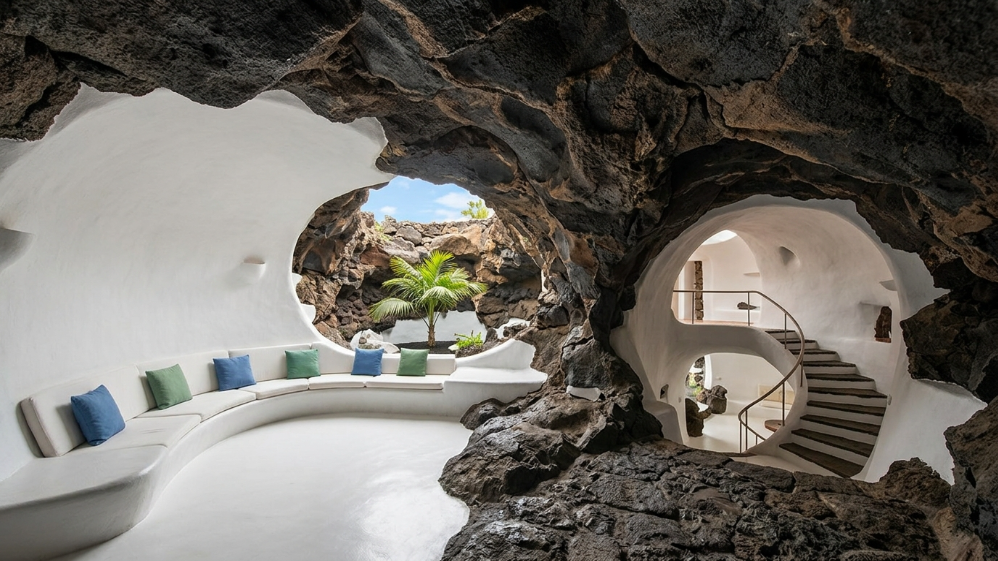
The Manrique route in a day
It can be done, and it works out perfectly. South to north:
Time Stop
9:30Fundación César Manrique (Tahíche) — start with his house: it sets the key for everything else.11:00Jardín de Cactus (Guatiza)12:30Cueva de los Verdes14:00Lunch in Arrieta or Órzola15:30Jameos del Agua17:00Mirador del Río (on a clear day; if it's hazy, swap it for Haría)
check opening times and bookings on the CACT website before setting off; some centres require a fixed date and time. And you'll need a car: none of these places are reachable by guagua (guagua: local word for bus).
Frequently asked questions
Who was César Manrique?
What are his most important works?
Can you see them all in one day?
Why are all the houses in Lanzarote white?
How did César Manrique die?
Where did he live?
There's something you only understand once you're here. After a couple of days driving around Lanzarote, you start noticing what's not there: no billboards, no towers, no signs shouting at you. Just white, black and green. And then it hits you that someone designed that visual silence, house by house, law by law, argument by argument, at a time when nobody understood why.
Lanzarote isn't an island that got lucky. It's an island that had César Manrique.