Let's start where nobody else does: there are no guachinches in Lanzarote.
Google it and you'll get lists, and some bars even put up the sign… but the guachinche (a small, family-run tavern serving home-made wine and simple food) belongs to Tenerife. The north of the island, to be precise. It started with small-scale winegrowers who, tired of selling their harvest for next to nothing, opened up their garages to sell their own wine and put out something to eat for whoever came in. It's such a proper institution there that it even has its own licence.
Gran Canaria has something similar: the bochinches. So what about here?
Here we have teleclubs. And their story is far better.
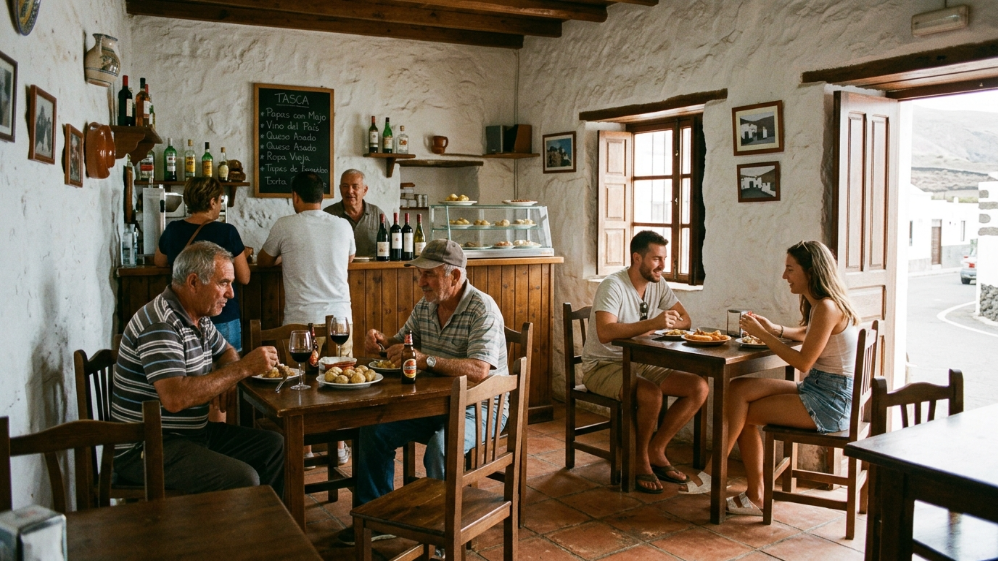 The teleclub: Lanzarote's answer
The 1960s. Lanzarote is a poor island, no tourism to speak of, with isolated villages where nobody owns a television. The regime decides rural Spain needs telly — and the news, above all the news — brought to it. So it sets up teleclubs: one venue per village, with a television set, where neighbours gathered to watch the one and only channel available.
Years went by, televisions arrived in people's homes, and the set itself stopped being the point. But the venue stayed. And since everyone already gathered there, it turned into what it still is today: the village bar, the social hub, the place where you eat.
In other words: while in Tenerife people gathered around wine, here they gathered around a television set. And out of both came exactly the same thing: an unpretentious place with home cooking, where the locals go.
The best-known is the Teleclub de Famara, which has become famous even beyond the island.
So where do the locals actually eat?
In four kinds of places. None of them have postcard sea views:
1. Teleclubs and village bars
Tinajo, Máguez, Soo, Tiagua, Yé, Uga, Tabayesco… Places with zero decoration, the telly on — football these days — prices from another era, and the kind of food you'd cook at home.
goat meat, rabbit, potaje (a hearty stew), grilled cheese, fish if you're near the coast. What not to expect: a menu in five languages, décor, or anyone in a hurry.
2. The bodegas of La Geria
And this is the exact equivalent of the Tenerife guachinche: winegrower + their own wine + simple food + the vineyard right outside. Same spirit, different island, different landscape.
3. The fishing villages
El Golfo, Arrieta, Punta Mujeres, Órzola. Modest terraces where the menu is whatever came in that morning. No teleclub here: just the sea.
4. El Charco de San Ginés (Arrecife)
The capital. Where the people who live and work on the island go for dinner, not the ones on holiday.
How to spot the real deal
No mystery to it. Look out for this:
✅ Good signs
- A chalkboard instead of a laminated menu
- You hear Canarian accents at the tables
- There are builders or locals eating at lunchtime
- The set lunch menu costs €10-12
- The place has strip lighting, not candles
- Nobody greets you at the door. In fact, they might take a while to even notice you
❌ Bad signs
- A menu with photos, in five languages
- Someone at the door inviting you in
- Sangria on the menu
- It's right on the seafront promenade
- Paella. In the Canaries. Think about that for a second
How to behave (this actually matters)
You're walking into the village bar, not a set built for your benefit. A handful of unwritten rules:
- Bring cash. Many don't have a card machine, and the ones that do would rather you didn't use it.
- Don't expect restaurant-style service. Here you sit down, say hello and order — at the bar, if need be.
- Say hello when you walk in. A simple "buenas" will do. Not doing it is the strangest thing you could possibly do.
- Eat at local hours: 2pm. Turn up at 4pm and the kitchen will be shut.
- There are no reservations. And if there's a queue, there's a queue.
- Don't turn it into a photo shoot. Keep the pictures to a minimum: there are people eating and working.
- Speak whatever language you like, but make the effort. A "gracias" goes further than a twenty-euro tip.
What to order so you can't go wrong
- Papas arrugadas (wrinkly salted potatoes) with mojo (the classic Canarian sauce) — the basic test
- Grilled goat's cheese — the classic Canarian starter
- Goat meat or rabbit in salmorejo (a garlicky marinade, not the Andalusian soup) — if you're inland
- Catch of the day — if you're on the coast
- A local wine — malvasía volcánica (the island's volcanic-grown white grape), simple as that
- Barraquito (a layered coffee with condensed milk, liqueur and cinnamon) for dessert — you'll see why everyone orders it
Frequently asked questions
Are there guachinches in Lanzarote?
What's a teleclub?
So why does everyone say "guachinche" anyway?
Is it cheap to eat there?
Do I need to book?
What if I don't speak Spanish?
Do I need a car?
Where to find them
The places on this island that are actually worth it don't top the app rankings: they're village bars with no website, no bookings, and nobody promoting them.
We're gradually pulling them together on LanzaEat, our directory of restaurants, bars and places to eat in Lanzarote — including the ones that never make it into any guide.
It's a bit dizzying when you think about it: the best places to eat on this island exist because a regime wanted the peasants to watch the news. It got away from them. The TV sets moved into people's homes, and the venue stayed full of neighbours, wine, conversation and food.
Sixty years on, that room with the strip lighting is still the most authentic food you'll find in Lanzarote. And it's in no guidebook.
Know a teleclub or village bar worth shouting about? Tell us 👇