About five thousand years ago, the La Corona volcano erupted. The lava flowed down towards the sea, and while the surface cooled and hardened, the river of fire kept running underneath. When it emptied out, it left behind a hollow tunnel about six kilometres long.
That tunnel has two sides to it. One is Jameos del Agua: polished, lit up, turned into a work of art. The other is this one: Cueva de los Verdes, pretty much as the volcano left it.
And it holds two things you're not expecting. One is history: people used to hide here from pirates. The other is a surprise at the end of the tour that we're not going to spoil for you, and it's the reason everyone who visits comes out recommending it.
 First things first: you need to book
This is the bit that ruins visits if you don't know it. The Cueva de los Verdes, just like Timanfaya, works on online booking for a specific time slot. Groups are limited and slots sell out.
- Book online, choosing a day and time, on the official CACT website.
- Turn up a few minutes early.
- Download your QR code onto your phone beforehand: signal out there isn't great.
- It's a guided visit. You can't wander in on your own or go at your own pace.
If you're also planning to see Timanfaya, book both at the same time and fit them into different days: the two sites are quite far apart. How to visit Timanfaya
What a volcanic tube is (in 30 seconds)
Lava flowing down a slope cools on the outside before it does on the inside. A hard crust forms, and underneath, the fire keeps flowing as if through a pipe. Once the eruption ends, that pipe is left empty.
The La Corona tube is one of the longest and most spectacular in the world, and it doesn't stop at the coast: it carries on a kilometre and a half under the ocean. That submerged section is known as the Atlantis Tunnel.
Along its length, some sections of the roof collapsed. Each collapse is called a jameo — which is where the name of the other end of the same tunnel comes from. Jameos del Agua and the CACT
The pirates: why this was a hiding place
During the 16th and 17th centuries, Lanzarote lived in terror of Barbary corsairs. They didn't just come to steal: they came to take people away to sell as slaves. The attacks were so frequent that the capital, Teguise, was built inland to hide from the sea.
And whenever a sail appeared on the horizon, plenty of people from the north headed up to the cave. They'd go kilometres in, carrying whatever they could, and wait for the ships to leave. At times, hundreds of people hid in here.
It didn't always work — there are accounts of raiders making it inside — but for decades this dark hole was half the island's life insurance.
The name, by the way, has nothing to do with colour. There's nothing green in here. It comes from the Verdes family, who owned this land. A surname, not a shade.
What the visit is like
You'll walk just under a kilometre — out of the tube's total six — in around 50 minutes, with a guide.
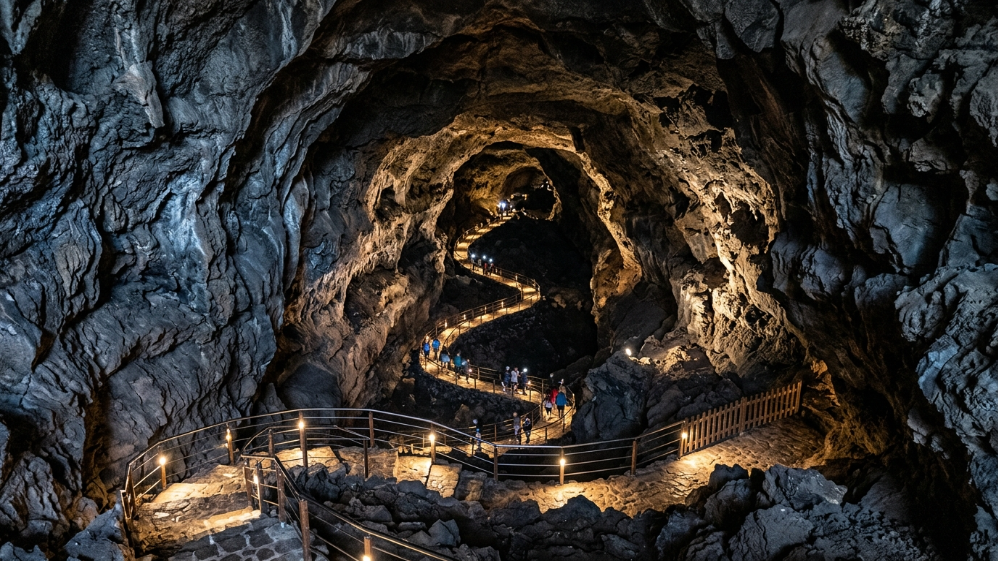
And this isn't a cave full of stalactites: it's something else entirely. The walls are lava frozen mid-flow, in colours ranging from black to ochre to red, petrified drips, ceilings that seem to weep stone. In some stretches the tunnel has two or even three levels stacked one on top of the other.
The lighting was designed by Jesús Soto, Manrique's longtime collaborator, and it's half the show: warm and cool lights that pull shapes out of the darkness. It's designed to show you exactly what needs to be seen, and nothing more.
Along the way there's an auditorium built right into the gallery, with extraordinary acoustics, where real concerts have been held.
And at the end there's something. Something you'll see with your own eyes and won't quite believe. We won't tell you what it is — that would spoil it — but pay attention when your guide stops the group and goes quiet.
Practical tips
- Bring a light jacket. It's around 18-19°C inside no matter how hot it is outside.
- Closed shoes with grip. The ground is uneven, with steps and damp patches. No flip-flops.
- Not suitable if you're claustrophobic or have mobility issues: there are narrow sections, stairs and low ceilings.
- No pushchairs allowed. With small children, use a baby carrier.
- Photography is tricky: low light and no flash allowed. Just enjoy it with your eyes.
- Allow an hour in total, including entry and waiting time.
- You'll need a car. How to get around Lanzarote
Pair it on the same day with Jameos del Agua (3 km away), the Mirador del Río and lunch in Arrieta or Órzola. It's the perfect day out up north. The perfect 3-day itinerary
Cueva de los Verdes or Jameos del Agua?
The question everyone asks. They're the same volcanic tube, three kilometres apart, but they show you opposite things:
Cueva de los Verdes Jameos del Agua
What it isThe volcano in almost raw formThe volcano turned into artVisitGuided, booked time slotFree, at your own paceAtmosphereUnderground, dark, geologicalBright, garden, lakeWith kidsFine, if they don't get overwhelmedGreatThe momentThe final surpriseThe lake of the blind crabs
if you can, do both on the same day. Few things on this island complement each other so well: first the raw cave, then what an artist did with the very same stone.
FAQs
Do you need to book Cueva de los Verdes in advance?
How long does the visit last?
Why is it called "de los Verdes" if there's nothing green there?
Is it suitable if you're claustrophobic?
What about with children?
Is it cold inside?
Is it the same as Jameos del Agua?
Just think about it for a second: for centuries, the people of this island came down into this hole in fear. They'd bring their children and whatever few belongings they had, put out the lights and wait in silence for the ships to leave.
Today we go down for fun, ticket booked online, and come out talking about how lovely the lighting was. The same rock, the same darkness, five hundred years on.