You drive up a road that climbs and climbs, park up, and see nothing at all. A stone wall, a door, and the wind. You start thinking you've come to the wrong place.
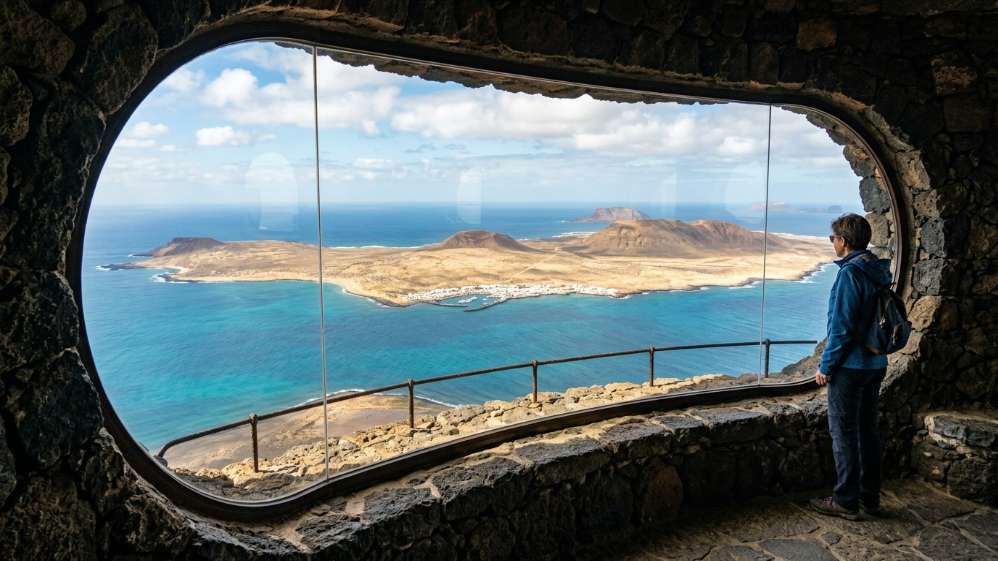
You go in. You walk down a curved passage cut into the rock. And suddenly a room opens up with two huge picture windows, and behind them the Atlantic almost five hundred metres below your feet, with La Graciosa floating down there as if someone had placed it just for the photo.
That's the Mirador del Río. And that dramatic reveal — hiding everything so the view hits you all at once — is exactly what Manrique wanted.
 What it is and why it's here
You're standing on top of the Risco de Famara, the natural wall that closes off Lanzarote to the north, some 475 metres above the sea.
The "Río" isn't a river. It's the name given to the stretch of sea that separates Lanzarote from La Graciosa: a narrow channel that, seen from up here, really does look like a blue river running between two stretches of land.
And Manrique didn't just pick this spot at random: there was already something here. In the late 19th century a military battery was set up here to watch over the channel — this was during the Cuban war years, when there were fears about the US fleet — taking advantage of the fact that from up here you can spot any ship coming from miles away.
In 1973, César Manrique, together with Jesús Soto and Eduardo Cáceres, turned that old military position into a viewpoint. And he applied his usual obsession: making sure it couldn't be seen. The building is buried into the hillside, covered in stone and earth, invisible from outside and from the sea. Looking up from La Graciosa, there's nothing to see.
What you'll see
The window room. The heart of the place: two huge openings looking out into thin air, with white vaulted ceilings and metal sculptures hanging from them. The idea is that the landscape comes in like a framed painting. It works.
The whole Chinijo archipelago. Below, La Graciosa with its two villages and beaches. Behind it, Montaña Clara and Alegranza, both uninhabited. And to the right, the Salinas del Río, the oldest salt flats in the Canaries, abandoned today, like a faded mosaic by the water.
The terrace. You step outside, right to the edge of the cliff. This is where you really feel the height — and where the wind really hits you.
The café. With the same picture windows. Sitting there with a drink, taking your time, is half the reason to come.
When to go (this is the important bit)
This is the place in Lanzarote that depends most on the weather. On a clear day, it's one of the best things you'll ever see. In mist, you see a white wall and you've paid to look at fog.
- Check the sky before heading up. If the north is clouded over, change your plans and leave the viewpoint for another day.
- Mist is more common in the morning and during the winter months. It usually clears up by mid-afternoon.
- With calima (Saharan dust haze) you also lose the view: the air turns hazy and La Graciosa fades into the distance.
- Bring a jacket. You're at 475 metres, in the north, right on the edge of a cliff: it's always windy up here, and noticeably cooler than down below.
head down to Haría, the Cueva de los Verdes or the Jameos, which don't depend on the sky. Haría and the Valley of a Thousand Palms
How to get there and practical info
It's right at the northern tip, along the road that climbs up from Yé. From Haría, around 15 minutes; from Costa Teguise, around 40; from Playa Blanca, over an hour.
You need a car. No guagua (local word for bus) comes up here. How to get around Lanzarote
It's one of the CACT sites, so there's an entry fee. Remember: the combined ticket covering several centres no longer exists, so each one is paid for separately. Check the price and opening times on the official website before heading up. Jameos del Agua and the CACT sites: which ones are worth it
Allow 45 minutes to an hour, taking your time with a coffee included. It's not a long visit: it's an intense one.
Combine it with the Jameos, the Cueva de los Verdes and Haría: everything's within 20 minutes and it makes for the best day out in the north. The perfect 3-day itinerary
And if you don't want to pay
Let's be honest: the road up has free viewpoints with similar views over the channel and La Graciosa. They're not the same thing — no room, no picture windows, no cantilevered terrace — but you do get the panorama.
If you're tight on budget, stop at one of those. If you can afford it, go in: what you're paying for here isn't the view, it's Manrique's idea. And that's only inside.
Frequently asked questions
Why is it called Mirador del Río?
Is it worth paying the entry fee?
How long does the visit take?
Can you get there by public transport?
Can you see La Graciosa from here?
Is it accessible?
With kids?
Some viewpoints are built to be seen. This one was built to disappear.
Manrique could have put up a glass terrace here that could be seen from the sea, and it would have ended up on every postcard. Instead, he buried it in the rock, covered the building with stone and earth, and made sure the only thing you'd see was what had been there for millions of years.
It's his smallest work, and probably the one that best explains how he thought.