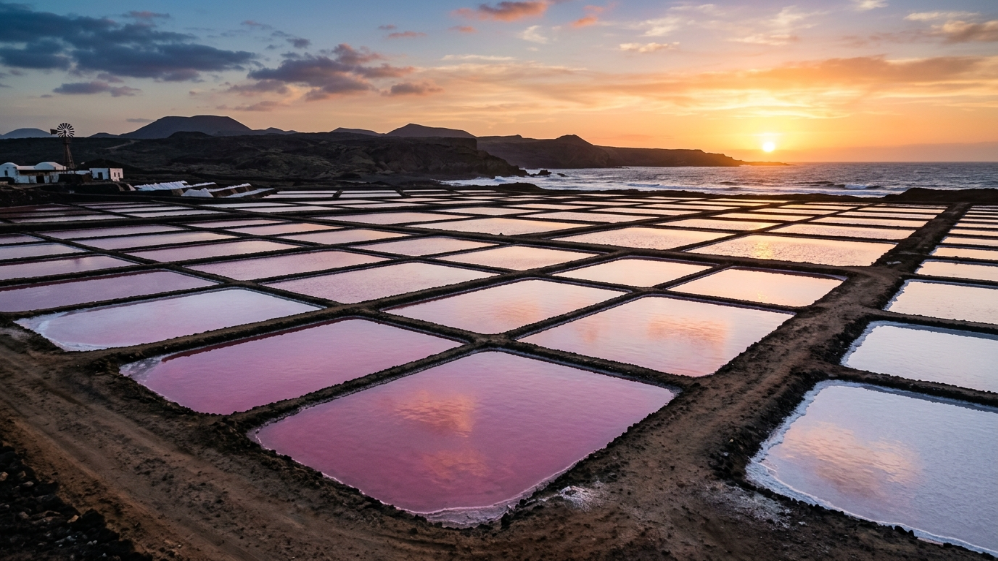
You're driving along the south coast, between black lava and a wild sea, when suddenly a chessboard of impossible colours appears: hundreds of squares of water, some pink, some white, some ochre, some almost violet, separated by low stone walls.
These are the Salinas de Janubio, the largest salt flats in the Canaries. And they're two things at once: a working salt factory and one of the most photogenic spots in Lanzarote.
 Where they came from (and here's the good bit)
This used to be a natural lagoon open to the sea. Until the 1730-1736 eruption came along, and the lava, flowing down towards the coast, sealed off the entrance, turning it into an enclosed lagoon of salt water.
So basically: catastrophe created the resource. And just as happened with the vineyards of La Geria, the people here looked at that disaster and asked themselves what could be made of it.
In the mid-19th century, work began on building the salt pans. And this was no small business: back then, salt was the fridge. Without it, there was no way to preserve fish, and Canarias lived off fishing on the Saharan bank. Boats set out loaded with salt from Janubio and came back with their catches salted inside. For decades, this lagoon fed half the island.
Then came industrial refrigeration, salt stopped being essential, and production collapsed. Today it still operates, but at a fraction of what it once was, and with a different product: artisan sea salt, sold as a delicacy.
How the salt is made (and why every pool is a different colour)
This is what makes the photo make sense:
- Seawater flows in to the lagoon and is pumped to the highest pools.
- It passes from one pool to the next, each time more slowly and getting warmer, evaporating under the sun and wind.
- At each stage, the water becomes more concentrated in salt — and that's the trick behind the colours: the concentration determines which algae and microorganisms survive in each pool. The more salt, the more the colour leans towards pink and red.
- In the final pools, the water can no longer hold any more dissolved salt and crystallises: a white crust forms, which is raked up by hand and piled into little pyramids.
No machines, no chemicals. Just sun, wind, time, and plenty of people pushing salt water from one square to the next. Exactly as it was done 150 years ago.
When to go: timing is everything
Sunset. It's not just a recommendation: it's the reason to come.
The salt flats face west, so in the late afternoon the sun hits them head-on and from the side: the water turns to mirror, the pinks light up, the salt pyramids turn gold, and the whole scene looks painted. It's one of the best sunsets in Lanzarote, and it goes head-to-head with Famara.
- At midday, with the sun overhead, the colours fade and it looks flat.
- The colours change with the season and the state of each pool: they're not always all pink. It's a living operation, not a set.
- With calima (Saharan dust haze), it loses a lot of its punch.
Where to stop (important)
There's a viewpoint on the road, with space to leave the car, from where you can see the whole thing. That's the good view: the panoramic shot of the entire board, with the sea behind it.
⚠️ Don't stop just anywhere on the verge. The south coast road is narrow, with bends and traffic, and there are stretches with poor visibility. And don't wander in between the pools: it's an active operation, with narrow walls and slippery ground, and there are people working there.
check whether there's a guided tour available — it's the way to really understand the process, and if it's on offer, it's well worth it, far more than just the photo from above.
And what's nearby
Janubio isn't a standalone visit: it's a stop along the best stretch of coastline on the island. Within fifteen minutes you've got:
- Los Hervideros (5 min): lava cliffs where the Atlantic surges in and explodes through the cracks. Free and brutal.
- El Golfo and the Charco de los Clicos (10 min): the green lagoon at the foot of a volcano split by the sea. El Golfo and the Charco de los Clicos
- Timanfaya (25 min). How to visit Timanfaya
- Playa Blanca and Papagayo (20 min). The best beaches in Lanzarote
Timanfaya in the morning → lunch in La Geria → El Golfo → Los Hervideros → sunset in Janubio. In that order, and for good reason. The perfect 3-day itinerary
And Janubio beach, right below: black sand and a gorgeous sea… with strong currents. It's one to admire, not to swim in.
Take some salt home
It's one of the best souvenirs you can bring back from this island: cheap, light, useful and local. You'll find it at Teguise market, in supermarkets and in local produce shops — look for Janubio sea salt, and if you can find it, the flor de sal ("salt flower", the finest layer that crystallises on the surface).
And there's something lovely about how the circle closes: papas arrugadas (wrinkly salted potatoes) are boiled with this very salt. What you see in those pools ends up on the plate you'll be eating from tonight.
FAQs
What are the Salinas de Janubio?
Can you visit them?
What's the best time to go?
Why is the water pink?
How long does it take?
Can you swim at Janubio beach?
Is there any wildlife?
In 1730, a volcano sealed off a lagoon and ruined half the island. A hundred and fifty years later, someone looked at the salty pool that was left behind and built a salt factory there.
It's the same old Lanzarote story: fire ruins everything, and then someone finds something in the wreckage. It happened with the wine in La Geria, with potatoes boiled in seawater, and it happened here too.
And this time, on top of it all, it turned out beautiful.