Almost nobody visits Arrecife. You land ten minutes away, drive past it on your way to somewhere else, and write it off: "it's just the city, there's nothing there".
And that's a mistake. Because this is the one part of Lanzarote that hasn't been dressed up for tourism: a proper working port city, with two castles, a seawater lagoon full of colourful boats right in the centre, the best tapas scene on the island, and city prices instead of resort prices.
It's not a postcard. It's something else: it's where people actually live.
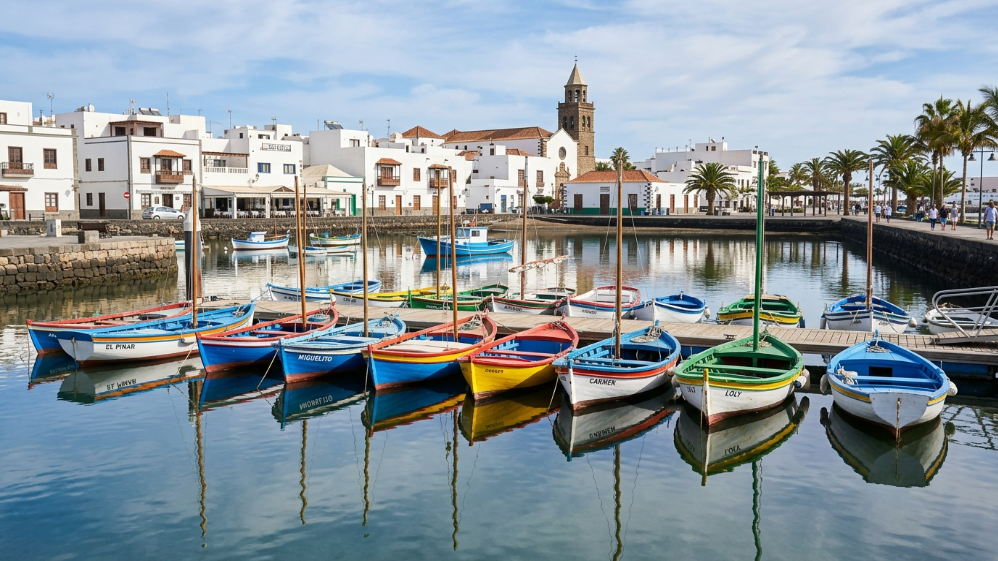 1. The Charco de San Ginés
The soul of the city, and the reason to come. A seawater lagoon tucked right into the middle of town, connected to the ocean by a channel, lined with low whitewashed houses and dotted with colourful little boats moored up, reflected in the water when it's calm.
This is what Arrecife was before it was anything: a handful of fishermen around a sheltered pool.
Today it's been turned around: a waterfront walk, terraces, and the best tapas spot in Lanzarote. This is where the people who work on the island come for dinner, not the ones on holiday.
at sunset. With the low light, the still water and the lights coming on, it's one of the prettiest corners in Lanzarote — and it's in a city nobody bothers to look at.
2. Castillo de San Gabriel and the Puente de las Bolas
On an islet facing the city, joined to the mainland by two stone bridges. The most famous is the Puente de las Bolas (Bridge of the Balls), with the two stone spheres on its pillars that have become Arrecife's unofficial symbol.
The castle dates from the 16th century, built —of course— against pirates, who raided this coast time and again. Today it houses the Museo de Historia de Arrecife (History Museum): the story of the city, the port and the island.
Even if you skip the museum, walk across the bridge at sunset. The views of the city from the islet are worth the five minutes.
3. Castillo de San José and the MIAC
Another fort, this one from the 18th century, perched above the Los Mármoles harbour. It was built during a famine to give people work — hence its nickname, "the hunger fortress".
Then in the 1970s César Manrique came along and turned it into the MIAC: the Museo Internacional de Arte Contemporáneo (International Museum of Contemporary Art). A black stone fortress on the outside, and inside, white galleries full of modern art, spiral staircases and a restaurant with picture windows looking out over the harbour.
It's the Manrique work fewest people visit, and one of the most elegant.
4. Playa del Reducto
The capital's city beach, and better than it sounds: golden sand, calm, sheltered waters, a seafront promenade and a blue flag, with the city right behind it.
It's not Papagayo, obviously. But if you're staying in Arrecife, or you've got a free afternoon, or you're travelling with kids and don't fancy hauling the cool box out to some far-flung cove, it does the job perfectly well.
5. The centre: Calle Real and San Ginés
Calle Real (officially León y Castillo) is the pedestrian spine of the centre: shops, terraces and the everyday bustle of a real city.
Just off it stands the Iglesia de San Ginés, the capital's parish church, whitewashed and simple, dedicated to the patron saint who gives his name to the big fiestas in August.
And towering over everything, the Gran Hotel: the tower that breaks up the city's skyline. It went up before the height restrictions championed by Manrique came into force, and it's the exception that proves the rule: the only tall building on an island where nothing is meant to stand taller than a palm tree. Take a look at it and you'll understand exactly why Manrique fought so hard for those rules.
How to plan your visit
Half an afternoon is enough. Arrecife is a walking city: Charco de San Ginés → Calle Real → Playa del Reducto → Castillo de San Gabriel at sunset → tapas. The MIAC is a bit further out, so it's better by car.
in the late afternoon and evening. During the day the city is at work; from around seven it comes to life, and that's when it's worth being there.
the one hassle. This is the one place on the island with pay zones and tricky streets — find a spot on the edge of the centre and walk in.
And this is one place the guagua (local bus) actually works well: Arrecife is the hub of the island's bus network, so it's one of the few spots you can reach without a car from almost any tourist town. Getting around Lanzarote
Staying here is the cheapest option on the island and it sits right in the geographic centre: a good base for short trips. Where to stay in Lanzarote
FAQs
Is it worth visiting Arrecife?
What is the Charco de San Ginés?
How much time do you need?
Can you get there without a car?
Is there a beach in Arrecife?
What castles are there?
Is it a good base to stay in?
Lanzarote sells you volcanoes, turquoise coves and white houses against black lava. And all of that is true.
But one day, once you've spent four days going from viewpoint to viewpoint, head down to Arrecife at sunset, sit by the Charco with a cold beer and watch the boats. There's nothing here designed for you. And that, oddly enough, is exactly why it's the closest you'll get to the real island.